Call Summaries vs Transcripts: Which Record Do You Actually Need?
Two Records of the Same Call
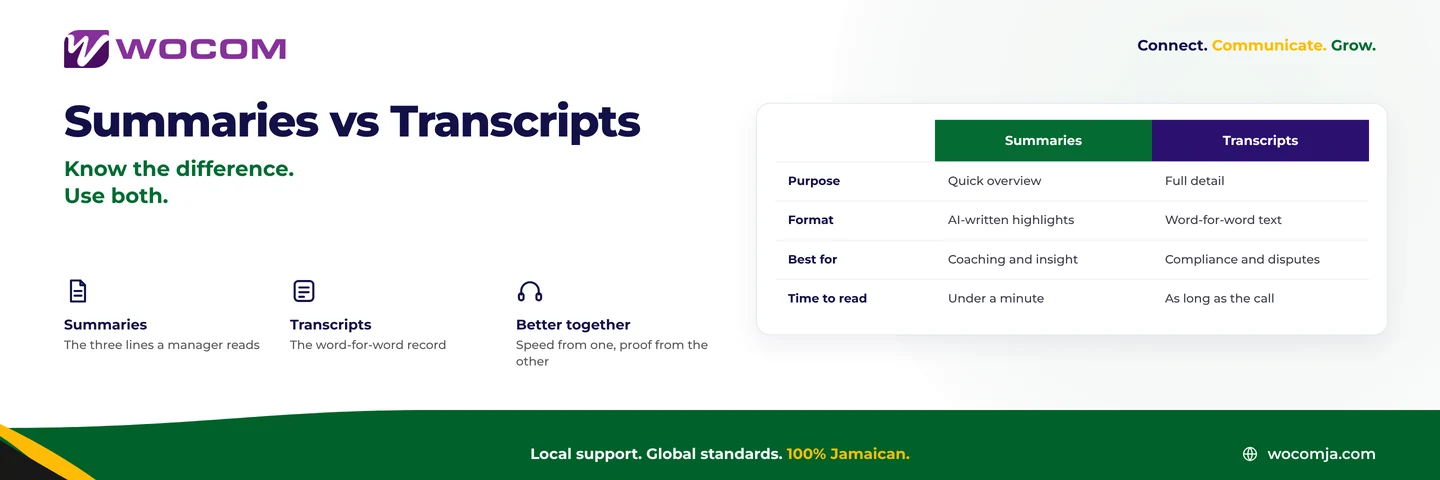
Every call handled on a WOCOM Cloud PBX produces two written records. A transcript is the whole conversation written out, word for word, with speakers separated and timestamps attached. A summary is a short AI-written account of what the call was about, what was decided and what happens next.
They are not competing features and one is not a lesser version of the other. They answer different questions, and businesses that understand the difference use both without thinking about it.
What Each One Is For
The transcript answers what exactly was said. It is the record you reach for when precision is the point: a dispute about what was quoted, a compliance review, a training session that turns on the phrasing an agent used.
The summary answers what happened. It is the record you reach for when volume is the point: forty calls came in yesterday and you need to know what they were about without reading forty conversations.
A typical summary runs to three or four lines — the caller, the request, the outcome, and any commitment made. It is written to be read in ten seconds by somebody who was not on the call.
When to Reach for the Summary
- The morning review. A manager scanning yesterday’s calls to see what needs attention.
- Handover. An agent picking up an account somebody else spoke to last week.
- Pipeline and follow-up. Which calls contained a commitment somebody now owes.
- Spotting a pattern. Twelve summaries mentioning the same delivery problem is a pattern visible in two minutes.
When Only the Transcript Will Do
- A dispute. “You said J$40,000” is settled by the sentence, not by a paraphrase of it.
- Compliance review. Whether a verification step happened is a question about exact words, and a summary is not evidence.
- Coaching on technique. How an objection was handled lives in the phrasing.
- Anything that may be looked at by a regulator or a lawyer. The full record, every time.
A summary is what the call was about. A transcript is what the call was. Never use the first where you need the second.
The Honest Limits of a Summary
A summary is generated from the transcript, which means two things.
First, it inherits the transcript’s errors. If a name or a figure transcribed badly, the summary carries the same mistake with more confidence and less context, because the surrounding words that would have made the error obvious are gone.
Second, it is an interpretation. A good one captures the outcome faithfully, but it is a compression, and compression loses things — the hesitation before the customer agreed, the second request they mentioned in passing. Where nuance matters, open the transcript.
This is why the pairing works. Read summaries to find the calls that matter; read the transcript of the ones that do.
A Workflow That Actually Gets Used
The habit that sticks in most Jamaican businesses looks like this:
- Daily: the person who owns the front of the business reads yesterday’s summaries. Ten minutes, no exceptions.
- Flag as you go: anything with an unresolved commitment, an unhappy caller, or a request nobody could answer.
- Weekly: open the transcripts of the flagged calls only. Usually five or six.
- Monthly: look at what the flags have in common. That list is your knowledge base backlog and your coaching plan, already written.
Pair it with sentiment analysis and the flagging becomes largely automatic: the calls where a positive summary sits over a negative sentiment score are almost always the interesting ones.
Storage, Retention and the Data Protection Act
Both records are personal data and both fall under the same obligations: tell callers, keep them only as long as you can justify, restrict access by role, and be able to find them if somebody makes a subject access request.
One practical point specific to this pairing — it is reasonable to hold summaries longer than transcripts, since they contain far less personal detail while still supporting continuity. If your retention policy currently treats both the same, that is worth revisiting. The transcription service guide covers the obligations in more detail.
Both Are Included
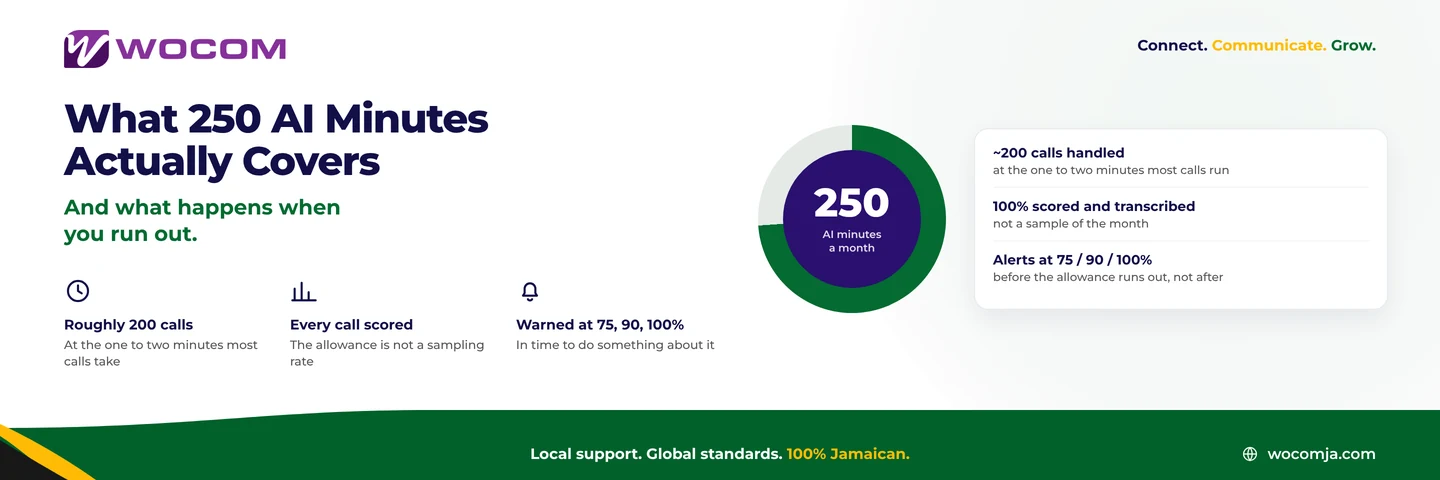
Transcription and summarisation are both part of AI Call Intelligence, included with every WOCOM Cloud PBX plan — neither is metered against your AI minutes allowance.
If you are only using one of them, you are probably reading too much or knowing too little. To have someone walk through both against your own calls, ring 876-906-7240 in Jamaica or 877-906-7240 from the US, email support@wocomja.com, or use the contact page.
Continue exploring
Ready to upgrade your communications?
Talk to our team about the right solution for your business.
Book a Demo Contact SalesMichelle Goss is a data and AI analyst at WOCOM, where she studies how Jamaican businesses use voice, messaging and AI to win and keep customers. With a BSc in Data Science & Analytics, she turns call data, customer trends and AI receptionist performance into practical guidance owners can act on. Michelle writes WOCOM's coverage of AI call handling, call analytics, customer growth and industry trends.