Agent Utilization Rate Jamaica: How to Measure Team Efficiency Without Burning Out Your Staff
What Is Agent Utilization Rate — and Why Does It Matter?
If you run a contact centre in Kingston or Montego Bay, you likely track how many calls come in, how long they last, and whether agents answered them quickly enough. But agent utilization rate sits one level deeper: it tells you what percentage of each paid shift your agents actually spend on call-handling work.
The formula is straightforward:
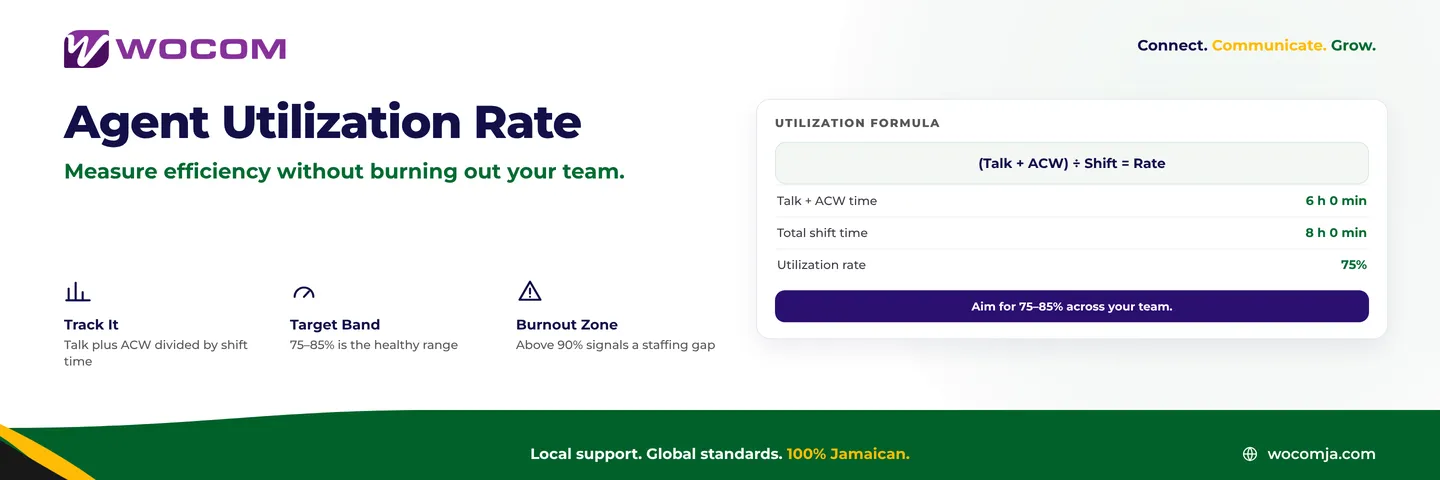
Agent Utilization Rate = (Total Talk Time + After-Call Work) ÷ Total Scheduled Shift Time × 100
If an agent is scheduled for an eight-hour shift and spends six of those hours talking to callers or completing post-call notes, their utilization rate is 75%. The remaining two hours cover scheduled breaks, team briefings, training time, and the natural gaps between calls.
This single number helps you answer two uncomfortable questions at once: Are we paying for more agents than we need? and Are we working our best people into the ground? Both answers cost money. Only one of them is obvious before it becomes a crisis.
Utilization Rate vs Occupancy Rate: Do Not Confuse the Two
Jamaican contact centre managers often use "utilization" and "occupancy" interchangeably. They measure different things, and treating them as identical will skew every staffing decision you make.
- Occupancy rate measures busy time as a fraction of logged-in time only. An agent who logs in, handles calls, takes a bathroom break, and logs out — their occupancy is measured only while they are actively at their station and logged into the queue.
- Utilization rate measures busy time as a fraction of the full scheduled shift, including scheduled breaks and off-phone activities such as training or team meetings. It is always lower than occupancy for the same agent on the same day.
You need both metrics, but for different decisions. Occupancy tells you how hard agents are working while they are at their desks. Utilization tells you whether your overall staffing model is efficient across the entire operating day — including every hour you are paying for.
What Counts as a Healthy Utilization Rate for a Jamaican Contact Centre?
Industry consensus places the healthy target band at 75–85% for inbound contact centres. Here is what each zone means in practice:
- Below 65%: Agents have too much unstructured idle time. You may be overstaffed relative to current call volumes, or your scheduling does not align with your actual demand peaks. Either way, you are spending payroll without proportionate return.
- 65–74%: Acceptable for teams carrying heavy training loads, handling complex multi-step calls, or running regular coaching sessions. Not a crisis, but worth reviewing your schedule mix against hourly call data.
- 75–85%: The target band for most operations. Agents are productive, queues are manageable, and there is enough natural buffer to absorb a spike in volume without the whole floor going into distress.
- 86–90%: Caution territory. A surge in call volume has nowhere to go. Agents are under constant pressure, and quality scores typically begin to slip before management notices the connection.
- Above 90%: Burnout territory. Sustained utilization above 90% correlates with rising agent attrition, falling customer satisfaction scores, and mistakes that end up costing far more than the apparent savings from running lean. This is not a staffing efficiency — it is a staffing debt.
Outbound-focused teams running sales campaigns or appointment reminders can tolerate targets slightly above this range because call pacing is more predictable. Even so, pushing past 88% for sustained periods is a retention risk that no Jamaican contact centre can afford in a competitive labour market.
Why Utilization Is So Hard to Improve Without the Right Data
The frustrating reality is that most Jamaican businesses track utilization informally, if at all. A supervisor walks the floor, sees agents between calls, and assumes the team is underworked. A queue backs up and the assumption is the team is overworked. Both impressions can be simultaneously wrong in different parts of the same shift.
Real improvement requires call-level data that most on-premise or legacy phone systems simply cannot produce cleanly:
- Per-agent talk time separated from after-call work time
- Logged-in time vs scheduled shift time for each agent
- Queue and abandonment data broken down by hour of day
- Correlation between utilization and average handle time — high utilization almost always drives longer calls, which further degrades the queue, which further raises utilization in a self-reinforcing loop
Without granular reporting, workforce decisions become guesswork layered on intuition. A contact centre running on a modern cloud platform with real-time wallboard data and exportable historical reports can spot a utilization trend within a week and correct a staffing schedule before it compounds into attrition or a visible service dip.
Practical Ways to Bring Utilization Into the Target Band
If your team is consistently running below 70%, the solution is rarely to simply reduce headcount. In most cases it is a scheduling alignment problem:
- Match your staffing peaks to your call peaks. Pull your hourly call volume data for the last 30 days. If your heaviest inbound traffic hits between 9 a.m. and noon and you have the same number of agents rostered from 8 a.m. to 5 p.m. throughout, you are scheduling for administrative convenience rather than demand reality.
- Consolidate routine training and briefings. Spreading a 20-minute team briefing across random moments in the shift creates unpredictable idle pockets. Scheduling it at a predictable low-volume window — often mid-morning for Jamaica businesses whose callers peak early and late — removes the randomness.
- Deflect routine enquiries to your AI receptionist. Calls that are genuinely answerable without a human agent — account balances, opening hours, directions, appointment confirmations — do not need to touch your utilization calculation at all. WOCOM's AI receptionist handles these calls end-to-end, freeing your agents for enquiries that actually need a person's judgement.
If your team is running above 88%, the conversation is entirely different. You need either more agents, meaningful call deflection, or both. Pushing through by extending shifts or cutting breaks only accelerates attrition. The replacement cost of a trained contact centre agent in Jamaica — recruiting, onboarding, and the productivity ramp to full competency — typically runs to several months of that agent's salary. Burning through people is not a cost-saving strategy; it is one of the most expensive operational decisions a business can make.
Get the Data Your Contact Centre Is Missing
If your current phone system cannot tell you what each agent's utilization rate was yesterday, you cannot manage it — you can only react after something goes wrong. WOCOM's cloud contact centre platform gives supervisors live per-agent metrics and historical utilization reporting alongside queue data, call recordings, and AI-assisted call handling that keep the rate healthy without exhausting your team.
Reach out to the WOCOM team today. We will walk you through what your utilization figures look like right now, what a healthy target looks like for your operation's size and call mix, and what it would realistically take to get there. Call us at 876-300-1877 or visit wocomenterprise.com/contact to book a no-obligation consultation with our contact centre specialists.
Continue exploring
Ready to upgrade your communications?
Talk to our team about the right solution for your business.
Book a Demo Contact SalesEverett Kildare is WOCOM's voice and infrastructure specialist, with more than 25 years of experience designing and running carrier-grade voice, SIP and virtualization infrastructure. Holding a BSc in Information Technology, he has built, secured and migrated phone systems for businesses of every size. Everett writes WOCOM's technical coverage of SIP trunking, cloud PBX, contact centres, business continuity and migration.