SIP Trunk Redundancy Jamaica: Active-Active vs Active-Standby Explained
Your SIP Trunk Goes Down. What Happens Next?
It happens without warning. A fibre cut in New Kingston, a carrier congestion event in Montego Bay, or a routing failure at a central exchange — and suddenly your business phones are silent. Customers get nothing. Sales enquiries disappear. Your team is staring at handsets that simply will not ring.
SIP trunk redundancy is the structural answer to this problem. But not all redundancy works the same way. The two standard approaches — active-active and active-standby — operate differently, cost differently, and suit different kinds of businesses. This guide explains both in plain language so you can choose before an outage forces the decision for you.
What SIP Trunk Redundancy Actually Means
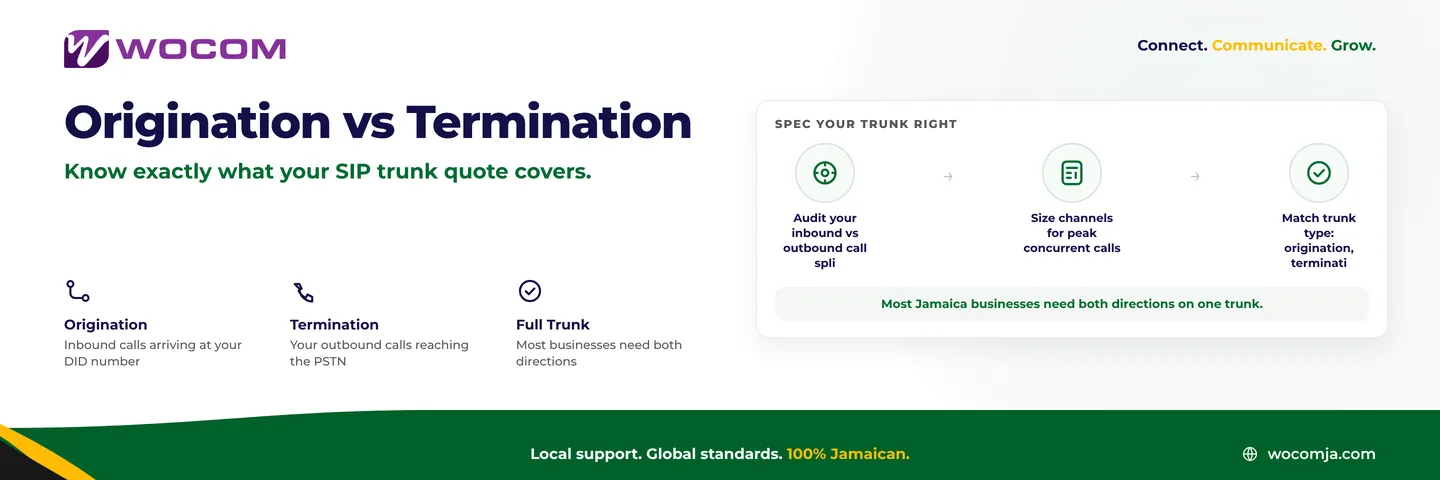
A SIP trunk is the connection between your phone system — whether an on-premise PBX or a cloud platform — and the public telephone network. It is the path your inbound and outbound calls travel. If that connection breaks, your phone system becomes an expensive piece of equipment that nobody can reach.
Redundancy means having a second path available so that when the primary trunk fails, calls continue without your team needing to intervene. The two trunk connections typically come from the same licensed carrier over physically separate routes, or from two entirely different carriers. The critical distinction between redundancy models is whether both trunks are active simultaneously, or whether one sits in reserve waiting to be called upon.
Active-Active: Both Trunks Working All the Time
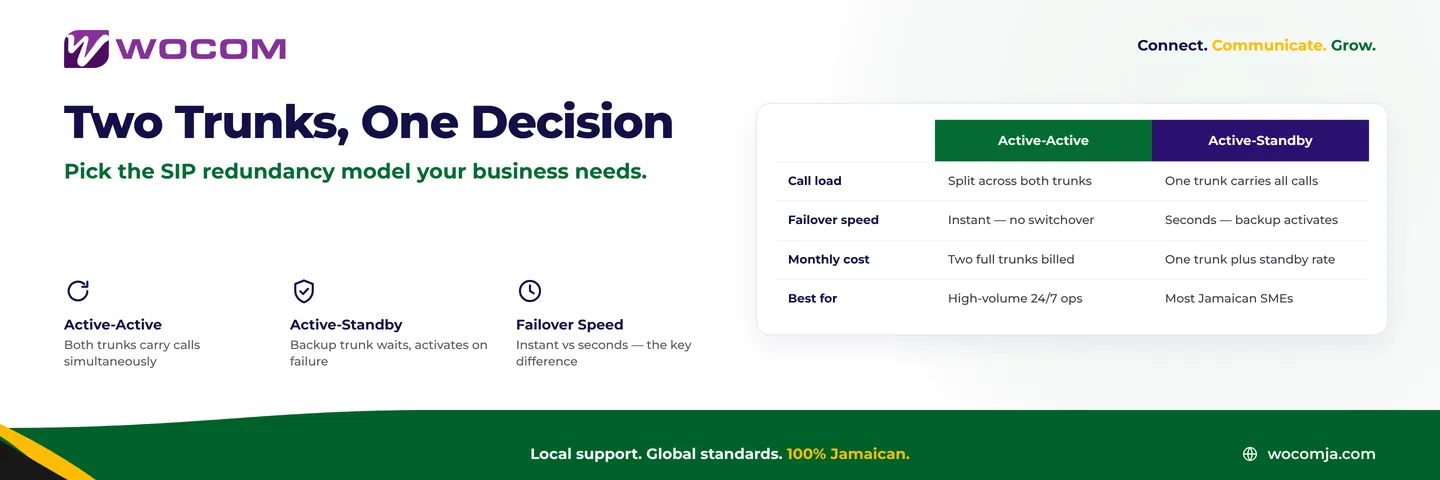
In an active-active configuration, your phone system is registered to two SIP trunks simultaneously. Inbound calls can arrive on either trunk. Outbound calls are distributed across both. If one trunk fails, the other immediately absorbs all traffic — there is no switchover delay because neither trunk was ever idle in the first place.
Advantages of active-active:
- Zero-second failover — callers experience no disruption whatsoever
- Doubles effective channel capacity, reducing congestion during peak call periods
- Load balancing spreads traffic so neither trunk becomes a bottleneck
- No single carrier dependency — a problem on one network path does not affect the other
Disadvantages of active-active:
- You pay for two full trunks at full capacity at all times, including overnight periods when call volume is near zero
- Requires a PBX or cloud platform that supports simultaneous multi-trunk registration and intelligent call distribution — not every system handles this cleanly out of the box
- More complex to configure correctly and to monitor ongoing
Active-active is best suited to businesses where a single dropped call carries significant financial consequence — a contact centre handling dozens of concurrent agents, a financial services desk, an emergency coordination line, or any high-volume inbound operation running around the clock in Kingston or Montego Bay.
Active-Standby: One Trunk Carries the Load, One Waits
In an active-standby configuration — sometimes called primary-secondary or failover mode — your phone system routes all calls through a designated primary SIP trunk. The secondary trunk is registered to the platform but carries no traffic under normal conditions. Your PBX monitors the primary trunk's health continuously, typically using SIP OPTIONS keepalive messages. When it detects a failure, it automatically redirects all new calls to the standby trunk.
Advantages of active-standby:
- Lower monthly cost — the standby trunk can be provisioned at a reduced channel count since it only needs to cover your peak volume, not double it
- Simpler to configure on most standard PBX and cloud platforms
- Protects against the most common failure modes: carrier outages, route failures, and upstream congestion events
- Straightforward to test — you can force a controlled failover during a low-traffic window without complex reconfiguration
Disadvantages of active-standby:
- Failover is not instant — there is a detection and switchover window, typically between five and thirty seconds depending on your keepalive settings
- Calls already in progress when the primary fails are dropped; only new calls route to the standby
- The standby trunk is never exercised under normal conditions, so silent configuration errors can go undetected until you actually need it
Active-standby suits the large majority of Jamaican SMEs well. A fifteen-second failover window during a carrier outage is far better than being unreachable for the hours it takes a carrier to restore service manually. For a medical clinic in Portmore, an insurance broker in New Kingston, or a freight office at the port — active-standby delivers meaningful resilience at a cost that is proportionate to the risk.
How to Choose: A Practical Decision Framework
Most businesses can answer this question with a few honest questions about their operation:
- What does a single missed inbound call cost your business? If the answer is a lost customer rather than a minor inconvenience, lean toward active-active.
- Do you run a contact centre or high-volume inbound operation? If agents are waiting on calls during business hours continuously, active-active pays for itself in reliability.
- How long can your business tolerate zero inbound calls? If thirty seconds of unreachability is operationally unacceptable, active-active is the only real solution.
- What is your typical daily inbound call volume? Businesses handling fewer than 100 calls per day rarely justify the additional monthly spend a full active-active setup requires.
- Do you carry regulatory or contractual uptime obligations? Financial services firms, healthcare providers, and utility-adjacent businesses sometimes have documented requirements that effectively mandate active-active.
A useful rule of thumb: if your business would generate significant concern among your customers for being unreachable for a single hour, invest in active-active. If a brief mid-afternoon outage would be noted but not catastrophic, active-standby with correctly tuned keepalives is the smarter spend.
The Configuration Details That Determine Whether Redundancy Actually Works
Whichever model you choose, redundancy only protects you if it is correctly configured and tested before you need it. Several common errors undermine otherwise sound setups:
Keepalive intervals: SIP OPTIONS keepalives are how your PBX detects a failed trunk. The default interval on many systems is 60 seconds — meaning your platform could take a full minute to notice the primary trunk is gone. Tightening this to 10 or 15 seconds significantly reduces the detection window without creating disruptive traffic on the connection.
Channel counts on the standby trunk: A frequent mistake is provisioning the standby with fewer channels than peak load actually demands. If your primary handles 20 simultaneous calls at midday and your standby only has 10 channels, half your callers still get a busy signal during an outage. Your standby channel count should match your realistic peak, not your average.
Failback behaviour: When the primary trunk recovers after an outage, does your system automatically return to it? Automatic failback is convenient but can cause a second disruption if the primary restores briefly and then fails again. For critical operations, manual failback with a confirmed health-check is more reliable.
Regular testing: An untested standby trunk is an unknown quantity. Schedule a forced failover test quarterly — during a Saturday morning window or after normal business hours — to confirm the secondary trunk accepts registrations, handles inbound calls correctly, and passes outbound traffic without issue. This single practice does more to validate your redundancy than any configuration review.
How WOCOM Delivers SIP Trunk Redundancy in Jamaica
WOCOM operates its own licensed network infrastructure in Jamaica, which means your SIP trunks terminate on carrier-grade equipment rather than a resold or aggregated connection from another provider. Both active-active and active-standby redundancy configurations are supported across our trunk platform.
For businesses that want active-standby without the configuration complexity, WOCOM's team handles keepalive interval tuning, channel sizing for the standby, and failback policy configuration as part of the standard setup. For contact centres and high-volume operations requiring active-active, our team configures load-balancing across both trunk paths and monitors both continuously.
Where the risk profile warrants it, we can also provision the secondary trunk path over a physically separate route — important in Jamaica, where a single cable event can affect multiple carriers simultaneously if they share infrastructure along the same corridor between exchanges.
Get Your SIP Trunk Redundancy Assessed
Whether you are setting up SIP trunks for the first time or reviewing an existing configuration that has never been tested under a real outage, WOCOM can evaluate your current exposure and recommend the right redundancy model for your call volume, budget, and business risk profile.
Contact WOCOM Jamaica today. Our team serves businesses across Kingston, Montego Bay, and island-wide, and can review your existing trunk setup without any obligation to change providers. Reach us at wocom.com or call our business team directly to arrange a technical review.
Continue exploring
Ready to upgrade your communications?
Talk to our team about the right solution for your business.
Book a Demo Contact SalesEverett Kildare is WOCOM's voice and infrastructure specialist, with more than 25 years of experience designing and running carrier-grade voice, SIP and virtualization infrastructure. Holding a BSc in Information Technology, he has built, secured and migrated phone systems for businesses of every size. Everett writes WOCOM's technical coverage of SIP trunking, cloud PBX, contact centres, business continuity and migration.