Dedicated Internet Access (DIA) for Business VoIP in Jamaica
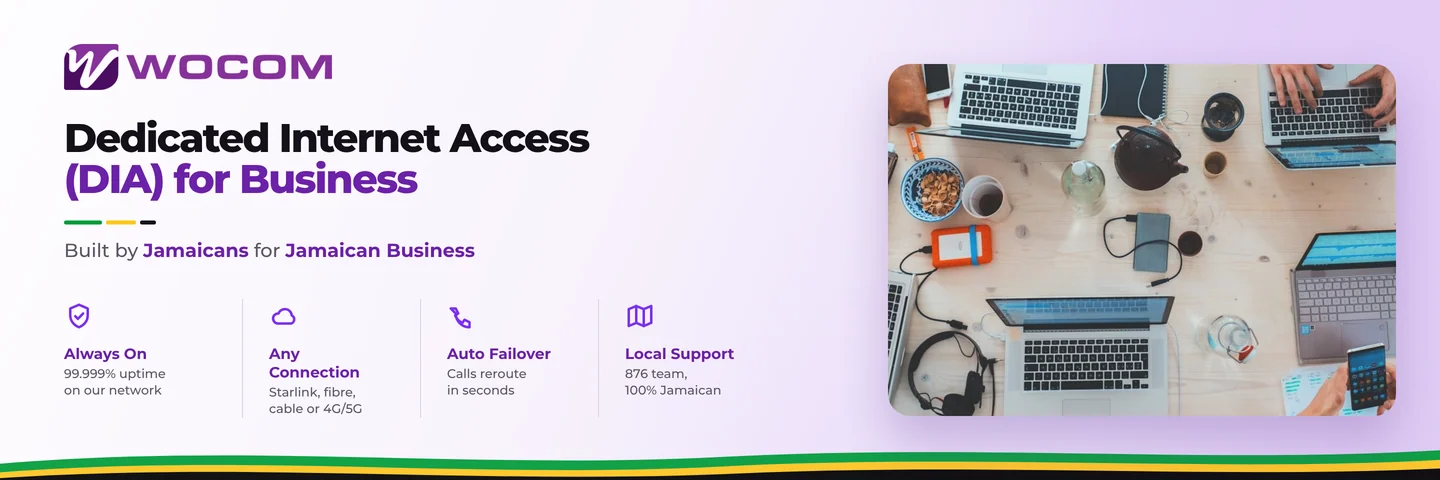
If your business runs on voice, dedicated internet access in Jamaica is the single biggest decision behind reliable, crystal-clear calls. Dedicated Internet Access (DIA) is a private, symmetrical, uncontended fibre line with a guaranteed amount of bandwidth and a binding Service Level Agreement (SLA). For business VoIP, especially contact centres and busy offices in New Kingston, downtown Kingston or Montego Bay, DIA is the gold standard, because your upload speed and your call quality never get squeezed by neighbours sharing the same pipe.
In this guide we explain what DIA actually is, the difference between contended and uncontended connections, why symmetrical bandwidth matters so much for voice, what an SLA and CIR really commit to, and when DIA is worth the premium versus when a good cable or fixed-wireless connection is enough. WOCOM is a licensed carrier that owns and operates its own network, so we deal with these trade-offs every day.
What is Dedicated Internet Access (DIA)?
Dedicated Internet Access is exactly what the name suggests: an internet connection that belongs to your business alone. The fibre capacity sold to you is reserved for you, end to end, and is not shared with other customers. That is the defining feature, and it is what separates DIA from almost every consumer and small-business broadband product on the market.
A DIA service has four characteristics that matter for voice:
- Dedicated and uncontended — the bandwidth is yours, not split among dozens of other premises.
- Symmetrical — your upload speed matches your download speed (for example 100Mbps up and 100Mbps down).
- Guaranteed (CIR) — a Committed Information Rate you can rely on around the clock, not a "best effort" figure.
- Backed by an SLA — written commitments on uptime, latency, jitter and how quickly faults are fixed.
For a deeper look at how DIA fits alongside cable, fixed-wireless and other choices, see our overview of business phone internet options in Jamaica.
Contended versus uncontended: the part that trips people up
Most affordable broadband is contended. The provider sells the same underlying capacity to many customers at once, on the safe bet that not everyone uses it heavily at the same moment. A "contention ratio" of, say, 20:1 means up to twenty premises may be sharing one slice of bandwidth. When the street is quiet, you get great speeds. When everyone logs on at 10am or after school lets out, you are all fighting for the same pipe.
An uncontended DIA line has a contention ratio of 1:1. Nobody else is on it. The speed you buy is the speed you get, at 9am on a Monday or 4pm on payday Friday. For a contact centre with thirty agents on calls simultaneously, that consistency is the whole ballgame, your calls do not start breaking up just because the wider neighbourhood got busy.
Symmetrical versus asymmetrical: why upload is king for voice
Consumer broadband is almost always asymmetrical, big download number, much smaller upload. That design suits streaming Netflix or browsing, where you mostly pull data down. Voice over IP is different: every call you make sends your audio up the line as much as it pulls audio down. Ten concurrent calls need solid upload capacity in both directions at the same time.
With an asymmetrical line advertised as "200Mbps", the upload might only be 20Mbps, and that ceiling is what limits how many clean simultaneous calls you can run. A symmetrical DIA line of 100Mbps gives you the full 100Mbps upward, so dozens of concurrent calls stay crisp even at peak. This is why we strongly favour DIA behind high-volume Flexi-SIP trunking deployments, the trunk is only ever as good as the upload feeding it.
We have written more about the everyday reality of running voice over shared lines in our piece on business phones over cable internet in Jamaica.
SLA and CIR explained in plain language
An SLA (Service Level Agreement) is the contract that turns a sales promise into an enforceable commitment. A serious business SLA spells out:
- Committed Information Rate (CIR) — the guaranteed minimum bandwidth available to you at all times. If you buy a 100Mbps CIR, that 100Mbps is contractually yours.
- Guaranteed uptime — the percentage of time the link is available. WOCOM's network is built to a 99.999% uptime SLA, which works out to only minutes of downtime across an entire year.
- Latency and jitter targets — voice is sensitive to delay and to variation in delay. Low, stable latency is what keeps conversations natural and free of echo or clipping.
- Defined repair times — a maximum time to respond and restore service when something does go wrong, with a real 876 support line behind it rather than an overseas queue.
Best-effort broadband offers none of these guarantees. It may run beautifully for months and then degrade at the worst possible moment, with no recourse. For mission-critical voice, the SLA is precisely what you are paying for.
DIA versus shared business broadband at a glance
| Feature | Dedicated Internet Access (DIA) | Shared business broadband |
|---|---|---|
| Bandwidth guarantee | Guaranteed CIR, always available | Best effort, varies with demand |
| Symmetry | Symmetrical (equal up and down) | Asymmetrical (small upload) |
| Contention | Uncontended (1:1, yours alone) | Contended (shared with others) |
| SLA | Uptime, latency and repair-time guarantees | Limited or none |
| Best for | Contact centres, larger offices, mission-critical voice | Small offices, light call volumes |
Who needs DIA, and who doesn't
DIA is a premium product, and it should be matched to the workload. It earns its keep where voice is the lifeblood of the operation:
- Contact centres — agents on calls all day, where a single bad minute is lost revenue and a frustrated customer. Pair DIA with our contact centre platform for the most resilient setup we offer.
- Larger offices — twenty, fifty or a hundred staff in a New Kingston or Montego Bay building, all leaning on the same connection for calls, video and cloud apps.
- Mission-critical voice — medical practices, financial services, dispatch and emergency-adjacent operations that simply cannot drop calls.
For a small office in Portmore with a handful of phones and modest call volumes, DIA is often more than you need. A quality cable or fixed-wireless connection, sized with enough upload headroom, can carry a few concurrent calls perfectly well, especially when the underlying voice service is engineered properly. The honest answer depends on your concurrent-call count and how much a dropped call actually costs you, and that is a conversation our team is happy to have.
How to think about cost in JMD
DIA carries a genuine premium over shared broadband, and there is a sound engineering reason: you are reserving capacity that the provider cannot resell to anyone else, plus the SLA, the monitoring and the priority support that sit behind it. Where contended broadband might be priced in the low tens of thousands of JMD per month, a dedicated symmetrical line with a real CIR and SLA typically sits meaningfully higher, scaling with the committed speed you choose.
The right way to frame it is cost per outcome, not cost per megabit. If your contact centre bills clients by the hour, or your sales floor lives and dies on connected calls, a few extra thousand dollars a month for a connection that does not wobble at peak is cheap insurance. If voice is a minor part of your day, paying the DIA premium would be over-buying. Speak to us with your seat count and call patterns and we will size it honestly rather than sell you headroom you will never touch.
Pairing DIA with automatic failover
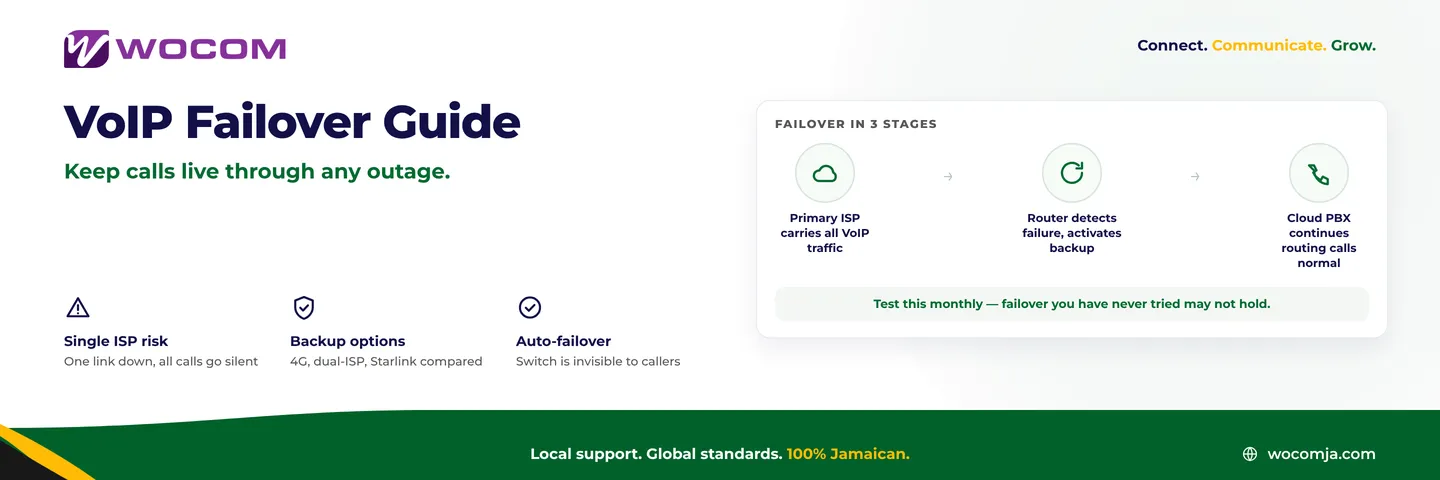
Even the most reliable single line is still a single line, and a backhoe through a fibre duct does not read SLAs. True resilience comes from dual-WAN: DIA as your primary, high-quality voice path, with a second, independent connection ready to take over the instant the primary blinks.
- 4G/5G mobile failover — a wireless backup on a different physical path, so a cut cable in your street does not take you offline.
- Starlink or fixed-wireless failover — satellite or radio backup that does not depend on the same ground infrastructure at all.
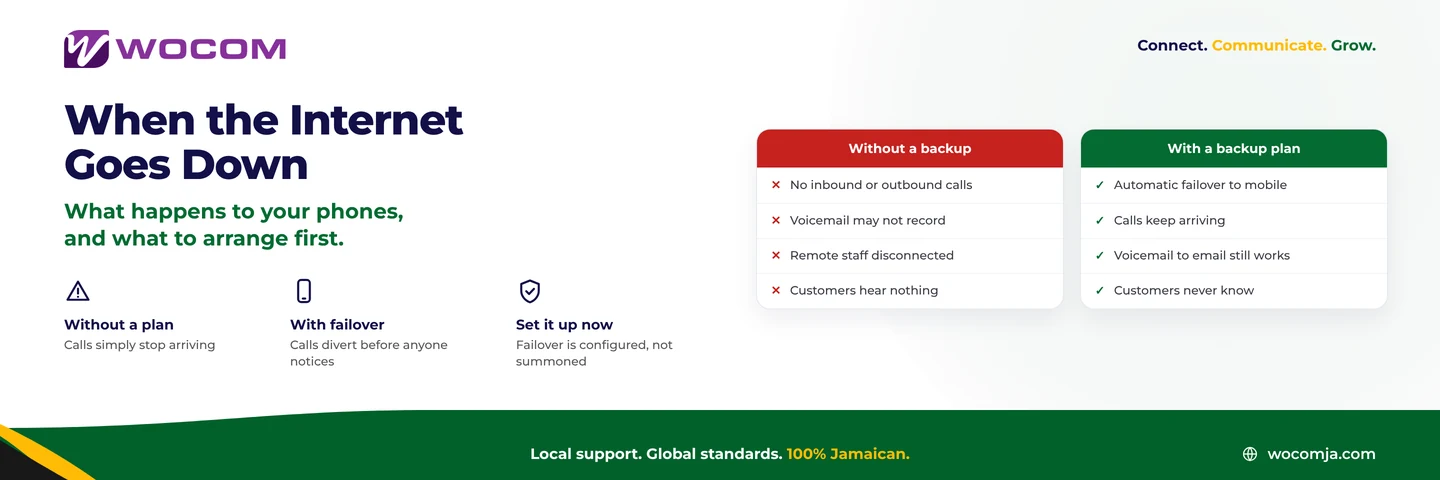
Configured for automatic cut-over, your calls keep flowing during a fault and most staff never even notice the switch. DIA gives you everyday excellence; failover gives you the guarantee that a bad day stays a non-event. Together with WOCOM's 99.999% uptime SLA, that is what business-grade continuity looks like.
Frequently Asked Questions
Is DIA the same as ordinary business fibre?
No. Plenty of "business fibre" packages are still contended and asymmetrical underneath, just sold under a business label. True DIA is uncontended (1:1), symmetrical, sold with a Committed Information Rate, and backed by an enforceable SLA. Always ask the provider to confirm the contention ratio and the upload speed in writing.
How much DIA bandwidth do I need for my call volume?
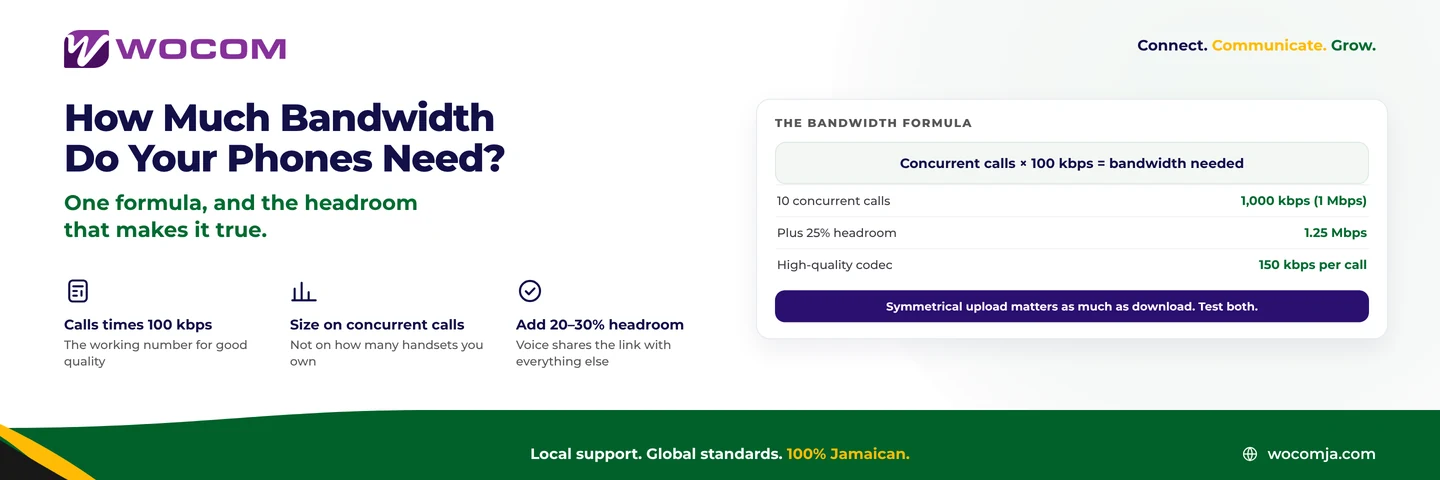
As a rough guide, each concurrent VoIP call uses roughly 100Kbps in each direction with common codecs, so even fifty simultaneous calls need only a few Mbps of guaranteed symmetrical capacity for voice alone. The bigger driver is everything else on the line, cloud apps, video, file transfers, so we size DIA around your total concurrent usage at peak, not just the calls. Share your seat count and we will work it out with you.
Can I use DIA with WOCOM's SIP trunks and contact centre?
Absolutely, that is the ideal pairing. A symmetrical, uncontended line is the perfect foundation for Flexi-SIP trunking and for our contact centre platform, because it removes the upload bottleneck that limits concurrent call quality on shared connections. Because WOCOM owns its own network, we can tune the whole path end to end.
What happens to my calls if the DIA line goes down?
With a dual-WAN setup, a 4G/5G or Starlink backup takes over automatically and your calls continue, usually without anyone noticing. Without failover, a primary outage would interrupt service until repair, which is why we recommend pairing any mission-critical DIA deployment with an independent backup path and our 99.999% uptime SLA.
Not sure whether your Kingston, Montego Bay or Portmore office needs full DIA or whether a well-engineered shared connection will do? Talk to WOCOM, a licensed Jamaican carrier that owns its own network, and our 876 team will size the right connection and failover plan for your call volumes, no over-selling.
Continue exploring
Ready to upgrade your communications?
Talk to our team about the right solution for your business.
Book a Demo Contact SalesEverett Kildare is WOCOM's voice and infrastructure specialist, with more than 25 years of experience designing and running carrier-grade voice, SIP and virtualization infrastructure. Holding a BSc in Information Technology, he has built, secured and migrated phone systems for businesses of every size. Everett writes WOCOM's technical coverage of SIP trunking, cloud PBX, contact centres, business continuity and migration.