876 Business Numbers Explained: Local DIDs, Toll-Free, and Porting in Jamaica
For most Jamaican business owners, the phone number is the front door. It is on the van, the flyer, the Instagram bio and the Google listing. Yet many businesses still run on a personal mobile, a number tied to one person and one handset. That choice quietly costs sales every time a call goes unanswered or rings out while someone is on the road. This guide explains how business phone numbers actually work in Jamaica, what your options are, and what to look for when you choose or move a number.
What a DID number actually is
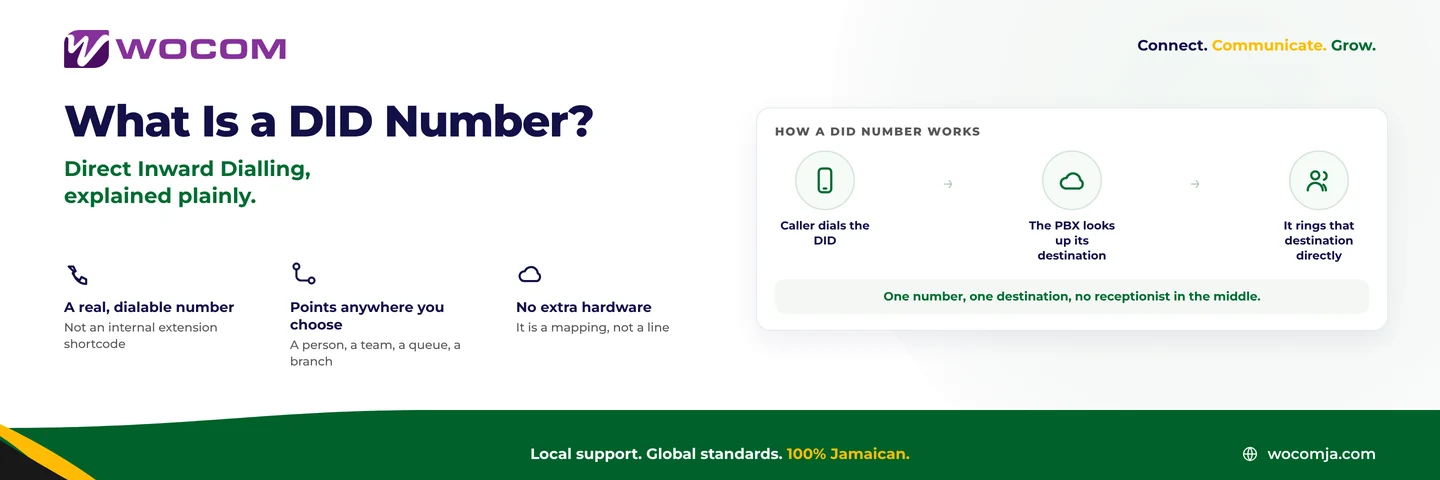
DID stands for Direct Inward Dialing. A DID is simply a phone number that routes a call directly to a destination you control, without going through a switchboard operator. Every business number you publish is, technically, a DID. What makes it powerful is that a DID is not bolted to a single SIM card or desk phone. It is a routable address on a carrier's network, and where it rings is entirely up to how you configure it.
That separation between the number and the device is the whole point. A personal mobile number can only ring that one phone. A proper DID can ring a desk phone, a mobile, an entire team, a Cloud PBX, or an AI receptionist, and you can change that routing in minutes without ever changing the number your customers know.
Local 876 numbers versus toll-free
In Jamaica you will generally choose between two kinds of business number, and they serve different jobs.
A local 876 number (Jamaica also uses the 658 overlay) reads as a real Jamaican business to anyone who sees it. It signals that you are here, you are reachable, and you are part of the local market. For most MSMEs, which make up more than 97% of the island's taxpaying businesses, a local number is the right default. It builds familiarity and trust, and customers pay their normal call rate to reach you.
A toll-free number (the 1-888, 1-800 and similar ranges) shifts the cost of the call onto your business instead of the caller. This makes sense when you want to remove any hesitation about calling, for example a support line, a sales hotline, a warranty desk, or a business that serves customers across Jamaica and the diaspora. Toll-free numbers also project a larger, more established image. Many businesses run both: a local number for everyday presence and a toll-free number for inbound sales and support.
Why a real business number captures more
A dedicated business number does two things a personal mobile cannot. First, it builds trust. Customers, suppliers and partners take a published business line more seriously than a personal cell, and they are more comfortable leaving messages, deposits and repeat business with a number that clearly belongs to a company rather than an individual.
Second, it captures every call. Because the number lives on the network and not on one phone, it can be answered no matter who is available. Calls can ring a whole team at once, roll over to a mobile after hours, or be handled around the clock by an automated receptionist. Nothing is lost because one person stepped away from their desk or left the company.
The number belongs to the business, not to whoever happens to be holding the phone that day. That single shift is what turns a phone line into an asset.
Virtual 876 phone numbers: how they work
A virtual 876 phone number is the clearest example of a DID working purely as software: a real Jamaican number that customers can dial, with no physical line, no wiring and no fixed address behind it. Because nothing is nailed to a building, it can be issued in days and pointed anywhere — which is why it suits home-based businesses, firms whose staff are spread across parishes, and overseas-owned companies that need a local Jamaican presence before they have an office here.
It is worth being precise about what a virtual number is not. It is not a second-class number: it ports, it carries caller ID, and it appears to your customer exactly like any other 876 line. The only difference is that its destination is a routing rule you control rather than a socket on a wall.
A virtual number is a DID with no physical line attached to it at all. It exists purely as a routing rule. This is what makes modern call handling so flexible. The same number can ring your front desk during opening hours, your mobile in the evening, and a backup line on weekends. You can split routing by time of day, by department, or by how busy your team is.
In practice that means a single published number can point to a Cloud PBX for your whole office, a SIP trunk feeding your existing phone system, a manager's mobile, or an AI receptionist that answers immediately when everyone else is tied up. You are no longer choosing between these options. You are deciding the order in which a call tries each of them.
New numbers versus porting your existing one
When you set up business phone service you have two paths. You can take a brand-new number, which is instant and lets you pick a clean local or toll-free line for a new branch or campaign. Or you can port the number you already use, bringing your existing, advertised number across to a new provider.
For an established business, porting usually matters more than people expect. Your number is printed on signage, saved in thousands of customer phones, indexed in search results and listed across directories. Changing it means losing inbound calls for months and paying to reprint everything. Keeping it removes all of that risk.
Number portability is your regulated right
Here is the part many owners do not realise: in Jamaica, keeping your number when you switch providers is a regulated right, not a favour. Under the framework that flows from the Telecommunications Act 2000, and overseen by the Office of Utilities Regulation (OUR) and the Spectrum Management Authority (SMA), providers are required to support number portability with minimal interruption to service.
In broad terms, a mobile number port typically completes in about 24 hours, while a landline or fixed business number can take up to about five business days. Business accounts need proof of authorisation, meaning documentation that confirms the person requesting the move is entitled to act for the business that holds the number. The rules are designed so the changeover happens cleanly, without long stretches where your line is dead. A good provider manages this process for you and coordinates the cutover so you are never left unreachable.
Multiple numbers for branches and departments
As you grow, one number is rarely enough. You may want a separate line for each branch, a dedicated number for sales versus support, or distinct numbers for marketing campaigns so you can measure which one drives the most calls. Because DIDs are virtual, adding numbers does not mean adding hardware. You can run dozens of numbers into the same system and route each one to the right team, while reporting tells you exactly where your calls are coming from.
Buy from a provider that owns its network
This is the detail that separates a reliable business line from a fragile one. Many companies that sell phone numbers are resellers. They buy capacity from someone else and pass it on, which means when something breaks they have to wait on the carrier above them, and they do not truly control your number.
A provider that issues and operates numbers on its own network controls the whole chain. It can provision new DIDs directly, manage your port end to end, fix faults with its own engineers, and stand behind a real uptime commitment. In Jamaica, that distinction also shows up in licensing: a Carrier Licence reflects a company that runs its own network, while a Service Provider Licence often sits on top of someone else's. When your customers' ability to reach you is on the line, owning the network is not a technicality. It is the difference between a provider who can fix your problem and one who can only file a ticket on your behalf.
Talk to WOCOM
WOCOM is a licensed Jamaican business phone provider that owns and operates its own network. We issue local and toll-free 876 business numbers and DIDs, provide SIP trunks from 4 to 128 channels, Cloud PBX, call analytics and a 24/7 AI receptionist named Alex who answers, books appointments, transfers calls and takes messages. We back it with a 99.999% uptime SLA, restoration by our own engineers, and local 876 support, and we handle your porting for you from start to finish. If you are setting up a new number or bringing your existing one across, book a demo or call us at 876-906-7240, visit wocomja.com, or email sales@wocomja.com, and we will get you on a number that works as hard as your business does.
Continue exploring
Ready to upgrade your communications?
Talk to our team about the right solution for your business.
Book a Demo Contact SalesEverett Kildare is WOCOM's voice and infrastructure specialist, with more than 25 years of experience designing and running carrier-grade voice, SIP and virtualization infrastructure. Holding a BSc in Information Technology, he has built, secured and migrated phone systems for businesses of every size. Everett writes WOCOM's technical coverage of SIP trunking, cloud PBX, contact centres, business continuity and migration.