The Hidden Risk of Buying a DID From a Reseller in Jamaica
A phone number looks like a commodity. One DID is the same as the next, so why not buy the cheapest one you can find? Plenty of Jamaican businesses think exactly that way — until the number stops working on a busy Monday morning and they discover, too late, that the company they bought it from cannot actually fix it.
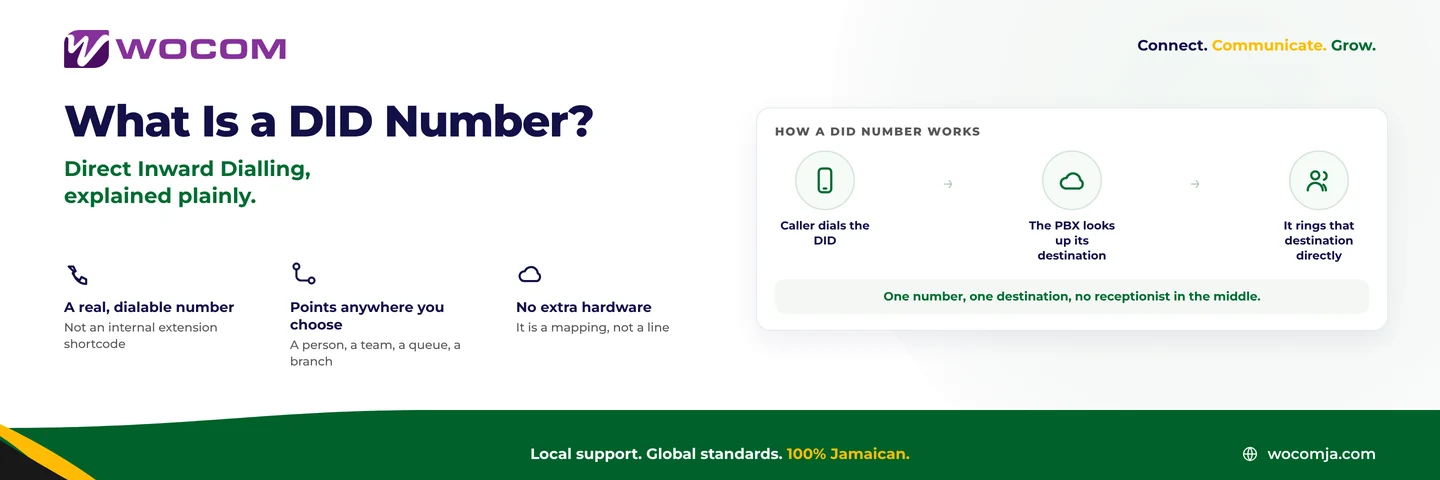
This is the hidden risk of buying a virtual DID, a SIP trunk, or a phone line from a reseller rather than from the provider who actually owns and operates the network. On a good day, you would never notice the difference. On a bad day, that difference is the reason your phones are dead and nobody can tell you when they will come back.
What a Reseller Actually Is
A reseller is a company that sells you telephone service without owning the infrastructure that delivers it. They buy capacity, numbers, or trunks from somewhere upstream and resell them to you with their branding on top. Sometimes that upstream supplier is itself a reseller, who bought from another party, who bought from a local licensed provider. By the time the service reaches you, it may have passed through three or four hands.
The reseller does not manage the switches. They do not control the routing. They did not provision the number on the network, and they cannot reconfigure it. They are, fundamentally, a billing relationship with a logo — a layer of paperwork between you and the company that actually runs the service.
When everything is working, this is invisible. The calls connect, the bill arrives, and life goes on. The problem is what happens when something breaks.
The Restoration Problem
This is where buying from a reseller becomes genuinely dangerous for a business. Imagine your DID stops routing calls. Customers calling your business get dead air or a failure tone. You call your reseller. Here is what actually happens next:
- The reseller cannot fix the fault themselves, because they do not control the infrastructure. So they open a support ticket with their supplier.
- That supplier — who may also be a reseller — opens a ticket with their upstream provider.
- Eventually the ticket reaches the company that actually operates the network and can make the change. That company does not know who you are. To them, you are not even a customer — you are a customer of a customer of a customer.
- You wait at the bottom of a chain you cannot see, with no ability to escalate, while every hour of downtime costs you sales and frustrates your callers.
This is why resold service so often leads to delayed restoration. It is not necessarily that anyone is incompetent — it is that the people you can reach cannot fix the problem, and the people who can fix the problem cannot be reached by you. You are reliant on a third party who is reliant on another third party. Nobody in that chain has made you a binding commitment about how fast your service will be restored, because none of them fully controls it.
Why Resellers Often Cannot Operate Reliably
Beyond restoration, resold telephone service frequently suffers from problems that come directly from not controlling the underlying system:
- No reliable configuration. A reseller may not have the systems set up to provision, route, and manage numbers in a stable, production-grade way. Changes you request — adding a channel, redirecting a number, setting up failover — depend on the cooperation of an upstream party.
- Inconsistent call quality. Calls may route through several intermediaries before reaching the destination. Each hop is an opportunity for latency, dropped calls, or one-way audio that nobody in the chain takes ownership of.
- Fragile continuity. If the reseller falls out with their supplier, stops paying them, or simply goes out of business, your service can vanish overnight — and the number you built your business around may go with it.
- No real SLA. A reseller cannot honestly promise you uptime or restoration targets they do not control. Any "guarantee" they offer is only as good as the deal they have with a party you have never met.
How to Tell If You Are Buying From a Reseller
You cannot always tell from a website — resellers and real providers can look identical online. You have to ask. Put these questions directly to any company before you buy a number or a trunk from them:
- "Do you own and operate the network this number lives on, or are you reselling another provider's service?"
- "When there is an outage, do your own engineers perform the restoration, or do you escalate to a supplier?"
- "Are you a licensed carrier or service provider in Jamaica?"
- "Can you show me a written SLA with specific uptime and restoration commitments?"
- "If I want to leave, can I port my number out — and how long does that take?"
Listen carefully to the answers. A direct provider answers plainly. A reseller hedges, references "partners" and "carriers," and cannot make firm commitments because the things you are asking about are not theirs to commit to.
The Bottom Line
A cheap DID from a reseller is not a bargain if it leaves your business unreachable for a day with no clear answer about when it will be fixed. For a single hobby line, the risk may be acceptable. For a business that depends on every call, it is not. The few dollars you save up front are nothing against the cost of lost sales, frustrated customers, and the helplessness of waiting on a chain of third parties you cannot influence.
Buy Direct With WOCOM
WOCOM owns and operates its own communications infrastructure in Jamaica. When you get a virtual DID or a SIP trunk from us, your number lives on our network — provisioned, routed, and managed by our own team. There is no reseller chain between you and your dial tone, which means when something needs attention, the people who can fix it are the same people who answer your call.
If you are tired of being at the bottom of someone else's support queue, talk to us. Call our local team, book a demo, or send a message, and we will show you what it is like to buy phone service directly from the company that actually runs it.
Continue exploring
Ready to upgrade your communications?
Talk to our team about the right solution for your business.
Book a Demo Contact SalesEverett Kildare is WOCOM's voice and infrastructure specialist, with more than 25 years of experience designing and running carrier-grade voice, SIP and virtualization infrastructure. Holding a BSc in Information Technology, he has built, secured and migrated phone systems for businesses of every size. Everett writes WOCOM's technical coverage of SIP trunking, cloud PBX, contact centres, business continuity and migration.