Will the AI Understand My Customers? How AI Receptionists Handle Jamaican Accents
When business owners in Kingston, Montego Bay, and across Jamaica first hear about AI phone receptionists, the questions usually start the same way: "But will it understand my customers?" It's a fair concern. Jamaica has one of the most distinctive linguistic landscapes in the Caribbean — a rich blend of Standard Jamaican English, Jamaican Creole (Patois), and regional accents that can shift dramatically from parish to parish.
Nobody wants to invest in an AI receptionist only to have it repeatedly ask callers to repeat themselves, misunderstand requests, or frustrate customers into hanging up. But here's what most business owners don't know: voice AI technology has come a very long way, and understanding how it works can help you make a smarter decision for your business.
How Voice AI Actually Processes Speech
Modern AI voice systems — including the engine behind WOCOM's Alex AI Receptionist — don't work the way old-school phone trees did. Traditional IVR systems required callers to say specific words from a fixed list. If a caller deviated even slightly from the expected phrase, the system would fail. "Press 1 or say billing" was about as sophisticated as it got.
Today's AI uses large-scale speech recognition models trained on hundreds of thousands of hours of real human speech from around the world. These models learn to identify intent — not just exact words. So when a caller says "Mi want to book an appointment" or "I calling to check on my order," the AI is matching the underlying meaning, not parsing a rigid script. This distinction matters enormously for Jamaican businesses. Your callers don't need to "speak properly" for an AI receptionist to help them. They just need to communicate their intent — something every caller naturally does.
The Patois Question: Where the Technology Stands
Let's be honest about the current state of things. Full Jamaican Patois — particularly heavy rural dialect or rapid creole conversation — remains a challenge for any AI system globally, not just WOCOM's. Patois is a full creole language with its own grammar, syntax, and vocabulary, and dedicated speech recognition models for it are still an emerging area of research.
However, this is less of a barrier in practice than most business owners expect, for a few important reasons:
- Most business calls use a blend. When Jamaicans call a business, they typically shift toward Standard Jamaican English — the same code-switching you do naturally when speaking at a job interview versus a family cookout. This means the vast majority of inbound business calls are handled well by current AI systems.
- AI handles Jamaican-accented English well. There is a meaningful difference between speaking Patois and speaking English with a strong Jamaican accent. Modern AI systems are significantly better at the latter, and most business-context calls fall into this category.
- Smart fallbacks protect your customers. When Alex isn't confident it understood a caller correctly, it asks a clarifying question or gracefully routes the call to a human — rather than making a wrong assumption. A well-designed AI knows what it doesn't know, and that matters.
Designing Your AI Setup for Jamaican Callers: Practical Tips
The biggest factor in how well your AI receptionist handles Jamaican callers isn't just the AI itself — it's how you configure it. Here's what makes the difference:
- Keep menu options simple and specific. Instead of open-ended prompts like "How can I help you today?", offer structured choices: "For sales, press 1. For support, press 2. To speak with reception, press 3." The simpler the path, the easier it is for any caller to navigate successfully.
- Write scripts the way Jamaicans actually speak. When configuring Alex's greetings and responses, write them naturally. "Good morning! Thanks for calling Caribbean Supplies — how can we help?" works better than stiff, formal corporate language that sounds foreign to your callers.
- Always include a clear route to a human. Build in an easy option to speak with a staff member. This isn't an admission that AI will fail — it's simply good customer service design. Even the best human receptionists transfer calls.
- Start with structured tasks before open conversations. AI receptionists perform best on well-defined tasks: capturing a name and number, confirming an appointment, routing a call to the right department. Use Alex for these first and expand as you get comfortable with how your customers interact.
- Set expectations in your outbound messaging. If you send customers WhatsApp messages or emails, include a line like: "Call us and our automated assistant will connect you quickly." Priming callers reduces frustration and improves their experience.
Why Jamaican Businesses Are Adopting AI Receptionists Anyway
Despite the accent question, AI receptionists are being adopted rapidly by Jamaican SMEs — and the reason is straightforward: the alternative is worse.
The alternative is a phone that rings out at 7 PM when your receptionist has gone home. It's a missed call on a Saturday morning from a customer in Portmore who is ready to book right now. It's a voicemail that doesn't get checked until Monday. Research consistently shows that more than 60% of callers who reach voicemail don't leave a message — they simply call your competitor instead.
An AI that understands 85% of your callers and handles them professionally is infinitely better than a phone that answers 0% of your after-hours calls.
For businesses in high-demand sectors — pharmacies, clinics, logistics companies, real estate offices, restaurants — the ability to handle calls 24 hours a day without adding to staff headcount is a genuine competitive advantage. And as AI voice technology continues to improve, the gap between AI comprehension and human comprehension will continue to narrow.
What's Coming Next for Caribbean Voice AI
Investment in Caribbean and Global South language AI is accelerating. Researchers at universities in Jamaica, Trinidad, and internationally are actively building Patois-specific speech datasets and recognition models. As this work matures, AI systems will become progressively better at understanding the full spectrum of Caribbean English and Creole — including the heavier patois that today's systems find most challenging.
WOCOM is committed to updating Alex's capabilities as the underlying technology evolves. Businesses that get comfortable with AI-assisted call handling now are the ones best positioned to take advantage of these improvements as they roll out. The learning curve is real — but the businesses already on it will have a head start.
The question isn't whether AI can perfectly handle every Jamaican caller today. The question is whether it can handle enough of them — professionally, reliably, and cost-effectively — to make a real difference to your business. For most Jamaican SMEs, the answer is already yes.
Hear Alex for Yourself — Book a Free Demo
The best way to settle the accent question is to hear Alex in action with your own ears. WOCOM offers a free consultation where you can experience exactly how an AI receptionist would interact with your specific business calls — including how it handles the kinds of questions and phrasings your customers actually use.
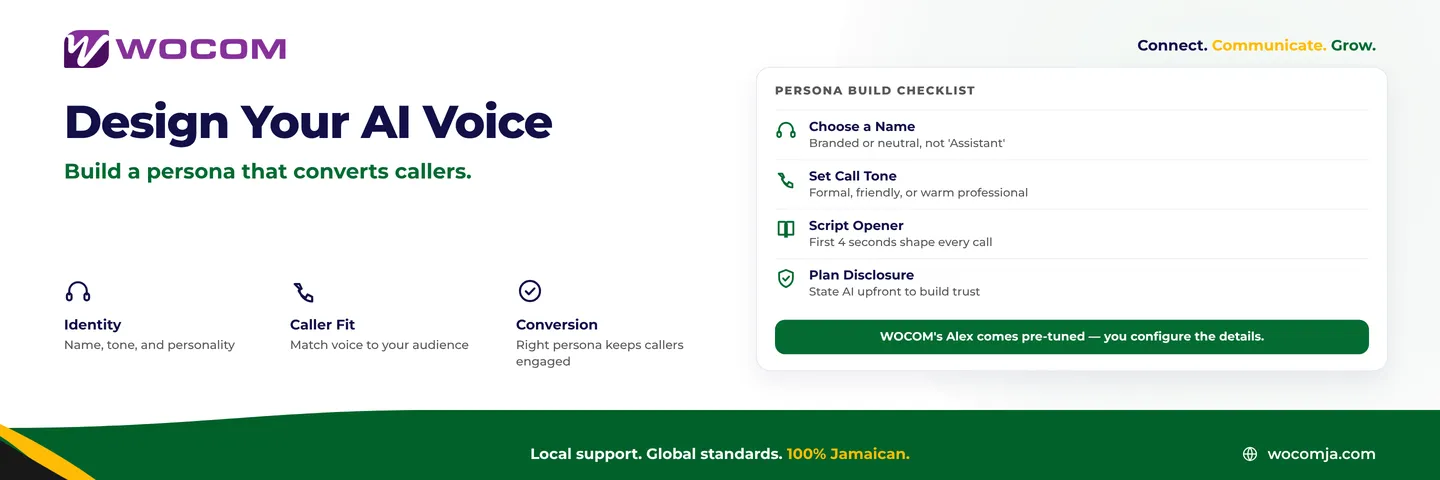
Stop wondering whether AI will work for your Jamaican customers. Find out for certain. Contact WOCOM today to book your free demo and discover how Alex can answer every call — day or night, weekday or weekend — so no customer ever reaches voicemail again.
Continue exploring
Ready to upgrade your communications?
Talk to our team about the right solution for your business.
Book a Demo Contact SalesMichelle Goss is a data and AI analyst at WOCOM, where she studies how Jamaican businesses use voice, messaging and AI to win and keep customers. With a BSc in Data Science & Analytics, she turns call data, customer trends and AI receptionist performance into practical guidance owners can act on. Michelle writes WOCOM's coverage of AI call handling, call analytics, customer growth and industry trends.