SIP Trunk vs Cloud PBX Jamaica: Which Phone Solution Does Your Business Actually Need?
Two Terms, One Constant Confusion
Walk into any business phone conversation in Jamaica and the terms get mixed together — SIP trunking, Cloud PBX, VoIP. Accountants, IT managers, and business owners use them as if they mean the same thing. They don't. And choosing the wrong one can either waste money or leave you with a solution that doesn't actually solve your problem.
This guide cuts through the noise. By the end, you will know exactly what each solution does, what it costs in the Jamaican market, and which one your business actually needs.
What Is SIP Trunking?
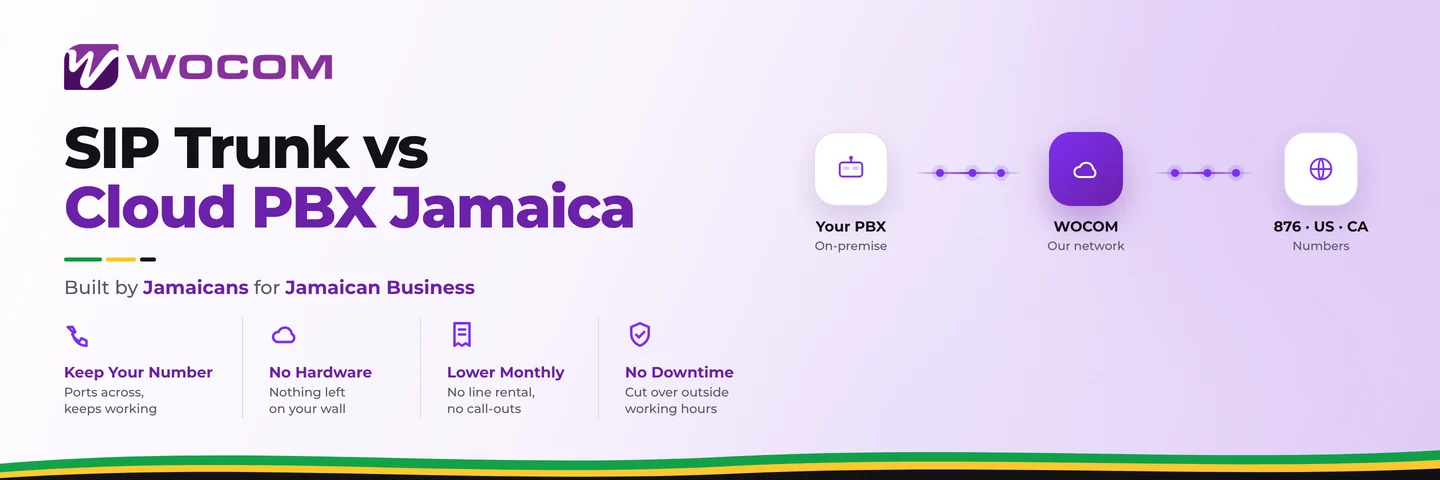
SIP trunking replaces your physical phone lines — the copper cables or ISDN connections — with internet-based voice channels. That is it. SIP trunks carry calls in and out of your building, but they do not manage those calls. They are the road, not the car.
If your business already has a PBX system on-site — whether that is an Avaya, Cisco, Panasonic, or any other brand — SIP trunking connects that existing system to the public phone network using your internet connection instead of traditional lines.
SIP trunking is the right solution when:
- You already own a PBX system and it works well
- You want to cut monthly line rental costs without replacing your hardware
- You need to add international numbers (US, Canada, UK) without physical infrastructure
- You run a BPO or contact centre with 20+ seats and existing on-premise equipment
- You want to consolidate multiple office locations onto a single voice platform
In practical terms: a Kingston law firm with a five-year-old Panasonic PBX and 12 staff can add SIP trunks, reduce its monthly line bill significantly, and gain a toll-free 1-800 number — without buying new hardware. That is SIP trunking doing exactly what it is designed for.
What Is Cloud PBX?
Cloud PBX is your entire phone system hosted in the cloud — no physical PBX box in your server room required. It includes everything: the dial plan, extensions, call routing, voicemail, auto-attendant, call queues, recording, and the lines themselves. You plug in IP phones or install a softphone app, and you are operational.
Think of Cloud PBX as the complete package — SIP trunks plus the intelligence to manage them, plus the features businesses need day-to-day, all bundled and maintained by the provider.
Cloud PBX is the right solution when:
- You are starting fresh with no existing PBX equipment
- Your current phone system is outdated, failing, or approaching end-of-life
- You have staff working remotely or spread across multiple locations — Kingston and Montego Bay, for example
- You want features like AI receptionist, call analytics, or WhatsApp integration without added complexity
- You do not want to maintain physical hardware or pay a dedicated IT person to manage a server room box
A Montego Bay tour operator with five agents, a remote manager in Kingston, and seasonal call spikes is a perfect Cloud PBX candidate. They do not need a server rack — they need phones that work from anywhere and scale up in December when bookings surge.
Cost Comparison: Jamaica 2026
Cost is where most businesses make their decision — and where the comparison gets genuinely interesting.
SIP trunking costs typically involve a per-channel fee (each simultaneous call uses one channel) plus a per-minute rate. In Jamaica, expect roughly US$8–15 per channel per month, with local call rates well below traditional PSTN pricing. The catch: you still need a working PBX to attach those trunks to, which means either maintaining existing hardware or purchasing a replacement.
Cloud PBX costs are per-user. At WOCOM, plans bundle local minutes, system features, and WOCOM AI — the AI receptionist — into a single monthly fee. No surprise infrastructure costs. For most Jamaican SMEs, this is straightforward to budget for.
The break-even point tends to fall around 15–20 users. Below that threshold, Cloud PBX almost always wins on total cost of ownership because you are not maintaining hardware. Above 20 seats with working equipment, SIP trunking onto an existing PBX may be more cost-effective — but only if that PBX is in good shape and your team can manage it.
One hidden cost businesses miss: when a traditional PBX fails, repairs or replacement can run J$300,000–800,000 and take weeks to resolve. Cloud PBX carries no equivalent risk — the infrastructure is maintained by the provider and covered under a service-level agreement.
The Key Question: Do You Already Have a PBX?
This is the most important question. Your existing infrastructure determines which direction makes financial sense.
If you have a functioning PBX less than seven years old: SIP trunking is worth exploring. You can extend the life of your equipment, reduce line costs immediately, and add features like international numbers without a full system replacement.
If your PBX is aging, failing, or approaching end-of-support: Do not invest in extending it. Migrate to Cloud PBX now and avoid the double spend — paying to keep old hardware alive, then replacing it anyway in two years when it finally gives out.
If you have no PBX at all: Cloud PBX is the clear answer. There is no capital expenditure, no hardware to manage, and you can be operational within days rather than weeks.
If you are a larger organisation with 30+ seats and complex call flows: A hybrid approach — SIP trunks feeding a managed or cloud-hosted PBX — may deliver the best outcome. WOCOM's enterprise team can design this architecture based on your actual setup and call volume.
What WOCOM Provides for Both Scenarios
WOCOM is a licensed telecommunications provider in Jamaica — one of the few that owns its own infrastructure rather than reselling capacity from a larger carrier. That matters for call quality, uptime guarantees, and direct accountability when something goes wrong.
For businesses that need SIP trunking, WOCOM provides carrier-grade SIP channels, local Jamaican DID numbers, US and Canada numbers, toll-free termination, and compatibility with all major PBX platforms including Cisco, Avaya, Panasonic, Yealink, and open-source systems like FreePBX and Asterisk.
For businesses moving to Cloud PBX, the platform includes auto-attendant, hunt groups, call queues, call recording, and WOCOM AI — the AI receptionist Alex — which handles calls around the clock, books appointments, captures messages, and transfers to the right person. Every Cloud PBX account includes WOCOM AI at no extra charge.
Ready to Choose the Right Solution?
Whether you are replacing old copper lines with SIP trunks or migrating your whole phone system to the cloud, the WOCOM team will assess your current setup and recommend the right path — not simply the most expensive option.
We serve businesses across Kingston, Montego Bay, Ocho Rios, Mandeville, Spanish Town, and every parish in between. Call us at 876-275-0218, reach us on WhatsApp, or visit wocomja.com to speak with a business phone specialist who knows the Jamaican market.
Continue exploring
Ready to upgrade your communications?
Talk to our team about the right solution for your business.
Book a Demo Contact SalesEverett Kildare is WOCOM's voice and infrastructure specialist, with more than 25 years of experience designing and running carrier-grade voice, SIP and virtualization infrastructure. Holding a BSc in Information Technology, he has built, secured and migrated phone systems for businesses of every size. Everett writes WOCOM's technical coverage of SIP trunking, cloud PBX, contact centres, business continuity and migration.