SIP Trunk Pricing Jamaica 2026: Per-Channel Costs, Setup Fees, and What's Actually Included
How SIP Trunk Pricing Actually Works
SIP trunk pricing in Jamaica isn't one-size-fits-all, and that's where most business owners run into trouble. You call a vendor, get a number, and have no frame of reference for whether it's reasonable. Let's fix that.
At its core, a SIP trunk gives your business a direct connection to the public telephone network via your internet connection. You pay for that connection — how the vendor structures that payment varies widely.
The three main pricing variables are:
- Number of channels — each channel supports one simultaneous call. A 5-channel trunk means 5 people can be on calls at the same time.
- Calling minutes — some plans include a bundled allowance; others charge per minute used.
- DID numbers (direct dial) — the actual Jamaican phone numbers your trunk delivers to callers.
Understanding these three levers lets you compare quotes fairly instead of picking the lowest headline number and discovering the rest of the cost later.
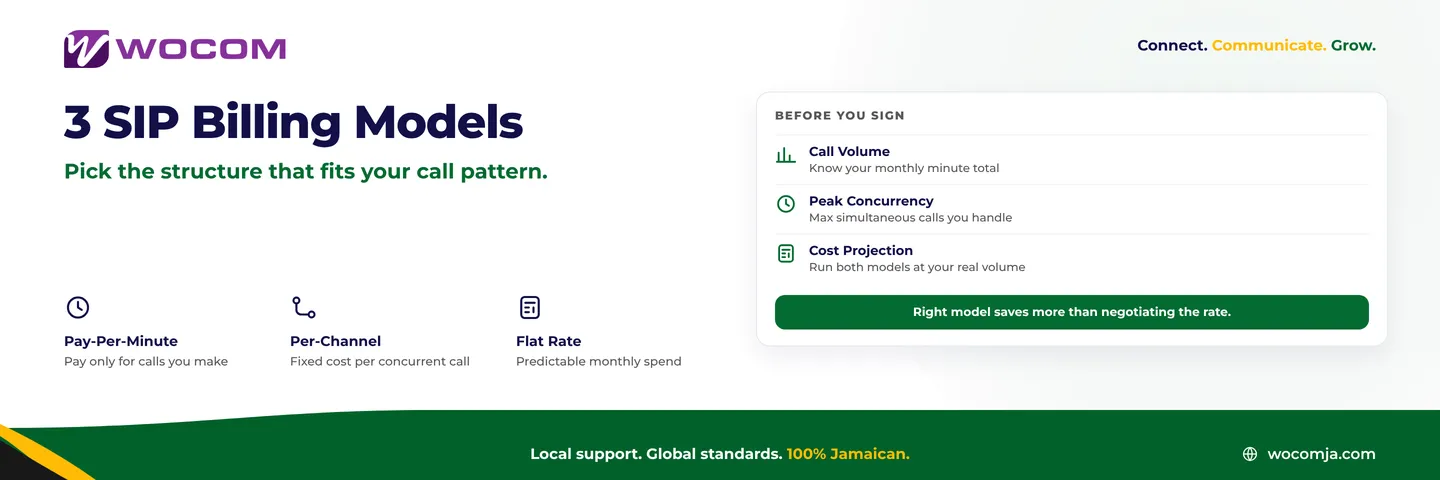
Per-Channel vs. Per-Minute Billing: Which Model Fits Your Business?
Jamaica SIP trunk providers typically offer one of two billing approaches, and the right choice depends heavily on your call patterns.
Per-channel (flat monthly): You pay a fixed monthly fee per simultaneous call channel, regardless of how many minutes you consume. This is predictable and suits businesses with steady, moderate call volumes — professional firms, multi-department offices in Kingston, and contact centres with consistent agent counts.
Per-minute (metered): You pay only for what you use. This suits businesses with irregular or seasonal call patterns — tourism operators in Negril, event companies, or contractors who are quiet for weeks and then slammed with calls. No wasted spend on idle channels.
Some providers also offer blended plans: a base monthly fee covering a set number of channels plus a bundled minute allowance, with per-minute rates for overages. These work well for growing businesses that want cost predictability but haven't yet stabilised their call volume.
When comparing quotes, always ask: what happens when I exceed my included minutes? Overage rates are where the real cost surprises hide — a cheap base plan with punishing overage rates can cost more than a higher flat-rate plan.
Setup, Porting, and One-Time Fees
The monthly cost is only part of the picture. Here is what vendors may charge you at the start:
- Setup or activation fee — some providers charge a one-time fee to provision your trunk. This ranges from zero to several thousand dollars depending on the vendor and the complexity of your setup.
- Number porting fee — if you are keeping your existing business number, you will need to port it. In Jamaica, porting typically involves a per-number fee and a waiting period of 5–15 business days. Get this in writing before you sign.
- New DID numbers — acquiring additional Jamaican local numbers (876 area code), toll-free numbers, or international DIDs usually carries a small monthly fee per number.
- Hardware or configuration fees — if your existing phone system needs a voice gateway to connect to SIP, the provider may bundle installation. Some include this free; others bill it separately.
A legitimate provider will itemise all of these upfront. If you receive a quote that shows only a monthly per-channel rate with no mention of setup or porting, ask specifically — never assume they are included.
What a Solid SIP Trunk Plan Should Include
Beyond minutes and channels, here is what every business-grade SIP trunk plan should cover without extra cost:
- CLI presentation — your outbound calls should display your business number to the person receiving them, not a random provider number.
- Inbound and outbound calling — some lower-tier providers offer only inbound DIDs. Verify you can make outbound calls on the same trunk before signing.
- Call failover — if your internet connection goes down, calls should reroute to a mobile or backup number automatically. Ask exactly how this is configured and tested.
- T.38 fax support — many Jamaican government agencies and financial institutions still require fax. Confirm the trunk supports fax-over-IP if your business sends or receives them.
- Responsive technical support — SIP trunk issues don't respect business hours. Confirm you have access to real support when problems arise, not just a ticket queue with a 48-hour response window.
Providers who own their own infrastructure — rather than reselling another carrier's capacity — consistently deliver better quality on these fundamentals. The route your call travels matters: a Kingston-to-Kingston call that gets routed internationally and back introduces delay and quality problems you will feel on every conversation.
Contract Terms and Red Flags to Watch
Price is important, but contract structure is where Jamaican businesses most often get caught out. Watch for:
- Long lock-in periods — a 24- or 36-month contract for a service you haven't yet tested is a significant risk. Reputable providers are comfortable with 12-month terms or shorter for new customers.
- Vague SLA language — "best effort" uptime means nothing enforceable. Your contract should specify a minimum uptime percentage (99.5% or higher) and what the provider does if they miss it, including any service credits.
- Unlicensed providers — in Jamaica, telephone service providers must hold a valid licence from OUR (the Office of Utilities Regulation). Buying SIP trunks from an unlicensed reseller leaves you with no regulatory recourse if service degrades or disappears. Verify the licence before you sign.
- Undisclosed international rates — if your business calls the US, Canada, the UK, or other international destinations regularly, get those per-minute rates in writing. Don't assume they are the same as local Jamaican calling rates.
- Rigid channel counts — even on an annual contract, confirm you can add or remove channels on a rolling basis as your team grows or contracts. Scaling your SIP trunk should never require renegotiating the entire agreement.
A SIP trunk is infrastructure — treat it like a utility contract, not a software subscription. Read the SLA, verify the licence, and get every fee documented before go-live.
How to Get a Quote That Actually Reflects Your Usage
Before you call any provider, gather three numbers: your approximate monthly call volume in minutes, your peak simultaneous calls (how many staff are on calls at the same time during your busiest hour), and the number of phone numbers you need to keep or acquire. With those three inputs, any serious SIP trunk provider can give you an accurate monthly cost quickly.
If a vendor cannot — or will not — price your requirements without pressuring you to sign up first, that is a signal worth paying attention to.
WOCOM operates its own licensed SIP infrastructure with local interconnects that keep Jamaican business calls on efficient domestic routes. Whether your customers are calling from Kingston, Montego Bay, or dialling in from the diaspora, your calls travel on infrastructure built specifically for Jamaica — not rerouted through overseas capacity that adds cost and degrades quality.
There are no surprises on the invoice because there is nothing hidden in the quote. WOCOM's team will size your trunk based on your actual call patterns, port your existing numbers without disruption, and give you the flexibility to scale channels as your business grows.
Contact WOCOM today for a transparent SIP trunk quote tailored to your usage — no lock-in pressure, no hidden fees.
Call us at 876-300-2929, send us a WhatsApp message, or visit wocomja.com to speak with the team.
Continue exploring
Ready to upgrade your communications?
Talk to our team about the right solution for your business.
Book a Demo Contact SalesEverett Kildare is WOCOM's voice and infrastructure specialist, with more than 25 years of experience designing and running carrier-grade voice, SIP and virtualization infrastructure. Holding a BSc in Information Technology, he has built, secured and migrated phone systems for businesses of every size. Everett writes WOCOM's technical coverage of SIP trunking, cloud PBX, contact centres, business continuity and migration.