SIP Trunk Channels Jamaica: How Many Concurrent Lines Does Your Business Actually Need?
What Is a SIP Channel — and Why Does the Number Matter?
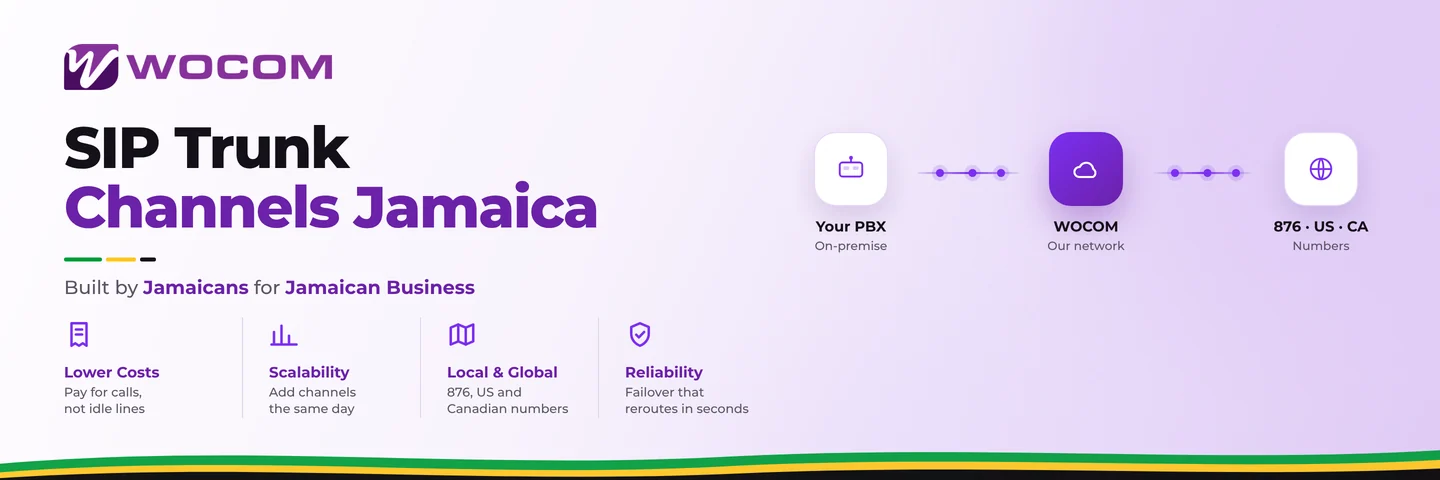
When you sign up for SIP trunking, you are not simply buying a phone number. You are buying concurrent call capacity. A SIP channel — sometimes called a voice channel or SIP trunk channel — is one simultaneous call path. If you have five channels, five calls can be active at the same time. The sixth caller hears a busy tone.
That distinction is critical. Unlike traditional copper lines where you had a physical wire for every call, SIP trunks share your internet connection and are sized by the number of calls you expect to be active simultaneously. Get the number wrong in either direction and you either overpay for capacity that sits idle or turn away customers during your busiest periods.
Most Jamaican businesses switching from legacy copper lines to SIP trunking underestimate how many concurrent calls they actually handle at peak. The guide below helps you get it right from day one.
How to Calculate the Right Number of SIP Channels
The starting point is your busy hour call count (BHCC) — the maximum number of simultaneous calls that could be active during your busiest period. Here is a straightforward four-step method:
- Count every staff member who takes or makes calls. If you have a 10-seat office and all 10 people could realistically be on calls at the same time, that is your ceiling.
- Add inbound and outbound together. If your receptionist handles inbound inquiries while your sales team makes outbound calls simultaneously, those channels stack against each other.
- Add a 20–30% buffer. Traffic spikes happen — a promotion, a storm warning, a news story about your sector. That buffer is what separates a smooth peak from a crisis.
- Review your old call records. If you are migrating from a traditional provider, your CDR (call detail records) show peak simultaneous call counts by hour. Ask WOCOM to analyse them for you before you commit to a channel count.
A Kingston law firm with eight lawyers and two receptionists typically needs 10–12 channels. A Montego Bay hotel front desk handling reservations, concierge requests, and internal transfers simultaneously might need 20–30. There is no universal answer — it depends entirely on your business type, call patterns, and how much overlap exists between your team's activity.
Industry Patterns That Shape Your Channel Count
Different sectors have very different concurrent call profiles. Understanding yours helps avoid both over-provisioning and the more costly mistake of under-provisioning.
- Retail and wholesale — Moderate concurrent volume with sharp peaks around promotions, month-end stock queries, and lunch hours. Plan for roughly 1.5× your average weekday peak.
- Financial services and cambios — High inbound frequency with short calls. Customers call often but rarely stay long — average duration of 90–120 seconds — so channels turn over quickly but still fill up during morning rushes.
- Medical clinics and pharmacies — Heavy morning spikes for appointment scheduling and prescription queries. Internal call transfers temporarily consume two channels simultaneously, which many practices do not account for.
- Courier and delivery companies — Outbound-heavy operations. Drivers calling dispatch, dispatchers calling customers, and customers calling about ETAs all happen at once. Needs more channels than headcount suggests.
- BPOs and contact centres — The most channel-intensive use case. Every agent seat maps to at least one channel, plus supervisor monitoring, call recording, and overflow routing each add overhead. Typically plan 15–20% more channels than agent seats.
Burst Capacity: Planning for the Day Everything Rings at Once
Every Jamaican business has experienced an unexpected surge. Hurricane warnings, power restoration after a parish-wide outage, a social media post that goes wide — these create sudden call spikes with no relation to your normal traffic patterns.
On a traditional phone system, burst traffic simply produces busy signals for every caller who cannot get through. With SIP trunking, you have two options:
- Static burst buffer — You provision 20–30% more channels than your normal peak requires. Cost is modest and protection is solid for moderate spikes.
- Dynamic burst (elastic SIP) — Your provider allows channels to expand automatically up to a pre-agreed ceiling during spikes, then contract afterwards. You pay only for what you use above your base allocation.
WOCOM's SIP trunks support elastic capacity. During August's Independence Day weekend, when hospitality businesses across Kingston and Montego Bay see three to four times their normal call volume, your trunk scales to absorb it — without you lifting a finger and without callers being turned away.
The Hidden Channel Consumers Most Businesses Miss
When calculating channel needs, most businesses count their people and stop there. But several other activities silently consume concurrent call capacity:
- IVR and auto-attendant menus — While a caller navigates your menu, they hold a channel even before reaching a staff member. If ten callers are working through your menu simultaneously, that is ten channels occupied.
- Music and messaging on hold — Parked and queued calls still consume a channel for the full duration they wait.
- Attended call transfers — During a warm transfer, the call briefly uses two channels simultaneously: one to keep the original caller and one to reach the transfer destination before connecting them.
- AI receptionist sessions — When WOCOM's Alex AI handles inbound calls, each session holds a channel for its duration. When Alex hands off to a human agent, the channel carries through seamlessly — but still counts.
- Call recording — Depending on your architecture, active recording may consume a media resource that counts against capacity. Confirm with your provider during onboarding.
For most small businesses, these extras add 10–15% to real-world channel demand. For contact centres processing hundreds of calls per hour, the overhead can be considerably higher.
How WOCOM Helps You Right-Size from Day One
The most reliable way to arrive at the right channel count is to let WOCOM analyse your existing call data before you commit. If you are currently on a traditional phone system, your provider's call records show concurrent call patterns across every hour of every day you have been in business. WOCOM's technical team can read those records and recommend a starting configuration — not an upsell number, the accurate number for your traffic profile.
Once you are live on WOCOM SIP trunking, your analytics dashboard shows real-time and historical concurrent call graphs. If you consistently approach your channel ceiling, adding capacity takes minutes. If you have over-provisioned, scaling down at renewal is equally straightforward.
This flexibility is one of the clearest advantages of modern SIP trunking over copper lines. You no longer negotiate a fixed line count once a year and live with it regardless of how your business grows or changes. You right-size continuously, and your costs reflect your actual usage.
Not sure how many SIP channels your Jamaica business needs? Contact WOCOM today and our technical team will review your current call volume — or build a capacity model from scratch for new setups. Visit wocomja.com/contact or call us to speak with an advisor. Getting this right upfront means no busy signals, no lost customers, and no overpaying for capacity you do not use.
Continue exploring
Ready to upgrade your communications?
Talk to our team about the right solution for your business.
Book a Demo Contact SalesEverett Kildare is WOCOM's voice and infrastructure specialist, with more than 25 years of experience designing and running carrier-grade voice, SIP and virtualization infrastructure. Holding a BSc in Information Technology, he has built, secured and migrated phone systems for businesses of every size. Everett writes WOCOM's technical coverage of SIP trunking, cloud PBX, contact centres, business continuity and migration.