How Many Phone Lines Does My Jamaica Business Need? A Practical Sizing Guide
The Problem With Guessing
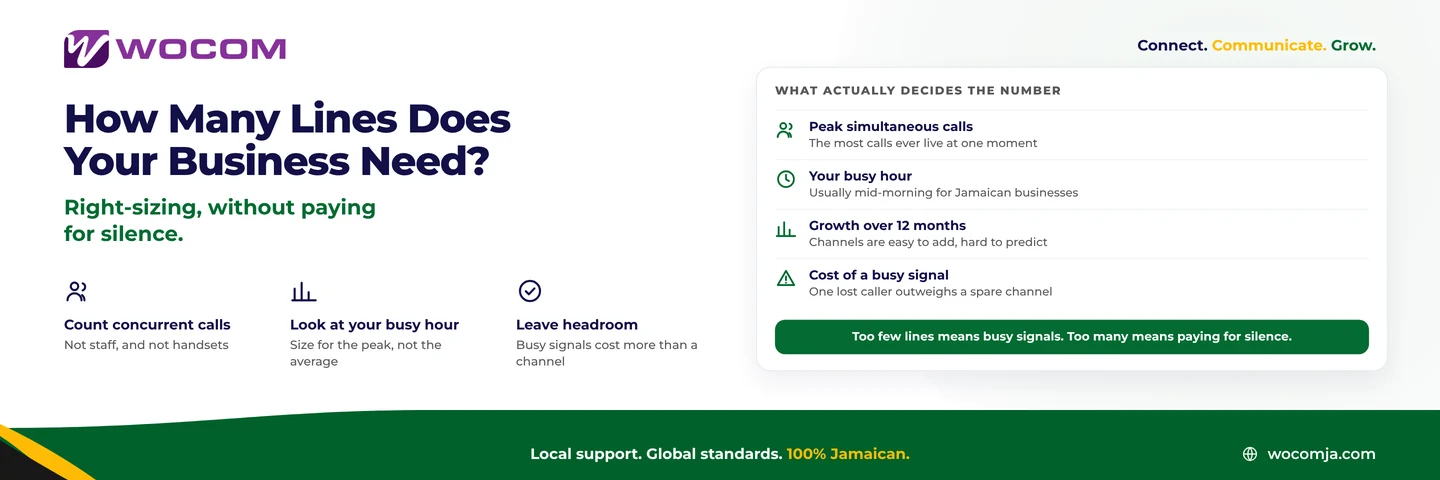
When Jamaican businesses set up their phone systems, most just guess. A small office gets two lines because that's what the provider suggested. A growing company in New Kingston adds a third line when staff start complaining. Nobody actually sits down and calculates what they need.
That guesswork costs money in two directions. Overpay and you're carrying dead lines that ring no one. Underprovision and callers hit a busy signal — and in Jamaica's competitive market, a busy signal is a customer calling your competitor next.
This guide gives you a real framework to size your phone system correctly, whether you're running a single-office operation in Montego Bay or a multi-branch business across the island.
The Old Way: Counting PSTN Lines
On traditional copper lines, each phone line supports exactly one call at a time. If you have three staff and all three are on calls, the fourth caller gets a busy signal. This made capacity planning feel harsh and mathematical.
The old rule of thumb in Jamaica was roughly one line per three staff members — assuming not everyone is on a call simultaneously. So a team of 15 would get five lines. This worked adequately for low-call-volume offices but breaks down the moment you have a busy spell or a seasonal spike.
The more rigorous version uses Erlang B traffic engineering — a formula that accounts for call arrival rate, average call duration, and acceptable blocking probability. The target for most businesses is a 1% blocking rate, meaning only 1 in 100 calls encounters a busy signal at peak.
What the Erlang Formula Actually Tells You
You don't need to run the math yourself, but understanding the inputs helps:
- Call arrival rate: How many inbound calls do you receive per hour at your busiest time? Not the average — the peak. Track this for a week.
- Average call duration: In minutes. Include hold time. For most Jamaican service businesses this is 3–6 minutes.
- Traffic intensity (Erlangs): Rate × duration ÷ 60. A business receiving 20 calls per hour averaging 4 minutes each carries 1.33 Erlangs of traffic.
- Blocking probability: The percentage of calls you'll accept hitting busy. 1% is standard for professional businesses; 0.1% for critical services like pharmacies or financial offices.
For 1.33 Erlangs at 1% blocking, the Erlang B table says you need 4 simultaneous call paths. Not 20, not 10 — four. That surprises most business owners who assumed one line per person was the minimum.
The Cloud PBX Difference: Why the Old Math No Longer Applies
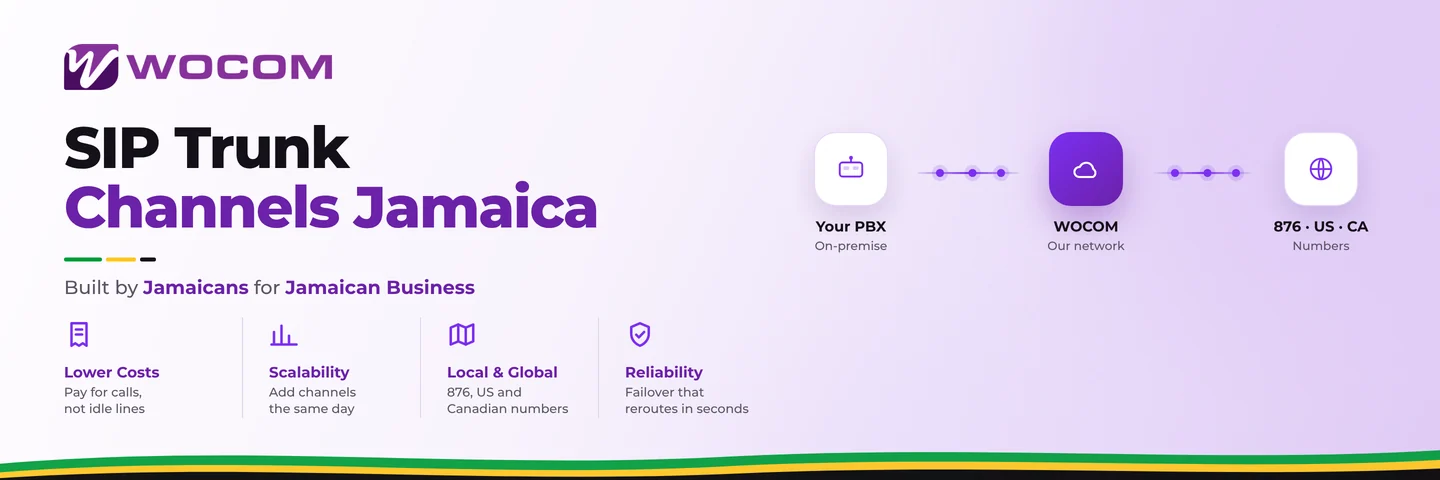
With traditional copper, every call consumed a physical circuit. With cloud PBX and SIP trunking, concurrent call capacity is a software setting, not a hardware constraint. You can start with 5 simultaneous call paths and scale to 50 the same day — no technician visit, no new wiring, no waiting weeks.
This matters for three common Jamaica business scenarios:
- Seasonal businesses: A tour operator in Ocho Rios that gets flooded with calls from November to April can burst to extra capacity for those months and scale back after. You pay for what you use.
- Growing businesses: A medical clinic adding two new doctors doesn't need to pre-provision ten extra lines. Capacity grows as you grow.
- Unpredictable spikes: A hardware store running a weekend sale, a pharmacy during a supply shortage — cloud capacity absorbs the spike without callers hitting a wall.
On a traditional phone line, a busy signal is a hardware limit. On cloud PBX, a busy signal is a configuration choice. You can almost always choose not to have one.
Practical Sizing by Business Type
If you don't want to run Erlang calculations, here are realistic starting points for Jamaica businesses on cloud PBX. These assume room to burst, not fixed capacity limits.
- Solo operator or home-based business (1–2 staff): 2 concurrent call paths. One active, one overflow to voicemail or the AI receptionist.
- Small office, 3–10 staff (Kingston boutique, accounting firm, small clinic): 4–6 concurrent paths. Most small offices never have more than 30–40% of staff on calls simultaneously.
- Mid-size business, 10–30 staff (car dealership, hotel front desk, insurance office): 8–15 concurrent paths. Factor in hold queues — a caller on hold still occupies a path.
- Call-heavy operations (contact centres, pharmacies, courier dispatch): Use Erlang B and size to 1% blocking at peak. A 10-agent contact centre typically needs 14–18 paths, not 10.
- Multi-location businesses: Each site gets its own calculation, but cloud PBX allows overflow routing between branches — a call that can't be answered in Portmore can ring through to Spanish Town automatically.
The Hidden Consumers: What Actually Eats Your Capacity
Several things use call paths that business owners forget to count:
- Hold queues: A customer sitting on hold is still using a path. If three people are holding, those are three paths your staff can't use for new calls.
- Auto-attendant navigation: While a caller listens to your menu options, they're occupying a path. Brief individually, but significant at volume.
- Conference bridges: A 5-person conference call can consume multiple paths depending on your system architecture — confirm with your provider.
- Outbound calls: If your staff makes outbound calls during the same hours inbound calls peak, you need to account for both directions in your calculation.
- Fax-over-IP: If you still send or receive fax (common with Jamaican government suppliers and some professional bodies), each fax transmission occupies a path for several minutes.
How to Review What You're Actually Using Right Now
If you're already on WOCOM's cloud PBX, your admin portal shows concurrent call data. Look for:
- The maximum simultaneous calls in any hour over the past 30 days
- Any "all paths busy" events in your call logs
- Calls that went to voicemail during business hours — a potential sign of silent capacity pressure
If you're on a traditional system without this data, do a manual observation: at your busiest hour on your busiest day, count how many lines are in use simultaneously. That's your measured peak — start your sizing calculation there.
Most WOCOM clients who review this data discover one of two things: they're paying for more capacity than they use, or they've been silently blocking calls at peak and never knew it.
What Right-Sizing Costs in Practice
On WOCOM's platform, concurrent call paths are bundled with your Cloud PBX plan and scale with your extension count — you don't pay per-line fees the way you would on legacy copper. Where a Jamaican business on traditional lines might spend J$15,000–J$30,000 per month maintaining multiple PSTN circuits just for capacity, cloud PBX rolls that into a single monthly plan at a lower total cost with far more flexibility.
The right answer to "how many lines do I need?" on cloud PBX is almost always: start with what covers your realistic peak, route overflow to AI or voicemail for the rare spike, and adjust quarterly as your business grows.
Get Your System Sized Correctly
WOCOM works with Jamaican businesses every day to size phone systems that match real call volumes — not guesses or oversold packages. Whether you're a three-person office in Half Way Tree or a 40-seat operation in New Kingston, we can review your usage data, run the capacity calculation, and recommend the right configuration.
Call us at 876-300-2929, email sales@wocomja.com, or visit wocomja.com to book a free consultation. Sizing your system correctly from day one stops customers from hitting a busy signal at your most important moments — and stops you from overpaying for capacity you'll never use.
Continue exploring
Ready to upgrade your communications?
Talk to our team about the right solution for your business.
Book a Demo Contact SalesEverett Kildare is WOCOM's voice and infrastructure specialist, with more than 25 years of experience designing and running carrier-grade voice, SIP and virtualization infrastructure. Holding a BSc in Information Technology, he has built, secured and migrated phone systems for businesses of every size. Everett writes WOCOM's technical coverage of SIP trunking, cloud PBX, contact centres, business continuity and migration.