Jamaica Business Phone System Costs: 7 Hidden Fees That Inflate Your Monthly Bill
A prospective client in Kingston recently shared a competitor's proposal with us. On the surface it appeared roughly J$3,000 a month cheaper than WOCOM. When we worked through the full contract together, the actual monthly outlay was J$7,500 higher — not lower. Setup fees, per-number rentals, a minimum channel commitment, and a support upgrade had all been itemised separately in the small print.
This is not an isolated incident. Business phone pricing in Jamaica is rarely as straightforward as the headline figure. Below are the seven cost areas that routinely materialise only after a contract is signed — and the exact questions to ask any provider before you commit.
1. Setup and Activation Fees
Many providers charge a one-time fee to activate SIP trunks, configure a hosted PBX, or migrate your existing numbers. Depending on the scale of the installation, this figure can range from a few thousand to tens of thousands of Jamaican dollars.
Ask: Is there a setup or activation fee? Is it waived for longer contract terms? What does it actually cover — hardware supply, configuration labour, or just account creation?
Some providers bundle initial setup into the monthly rate; others treat it as a separate project cost. Make sure you are comparing like for like before accepting any quote.
2. Per-Number (DID) Monthly Charges
Your monthly line rental is not always the same as your number rental. A hosted PBX plan might include three SIP channels but charge separately for each Direct Inward Dialling (DID) number assigned to those channels. If your business publishes ten numbers — for different departments, locations, or WhatsApp-linked lines — those ten DIDs may each carry their own monthly fee.
Ask: How many numbers are included in the base plan? What is the monthly cost per additional number? Are toll-free 1-888 numbers priced differently from local 876 numbers?
3. Minimum Channel Commitments
SIP trunking is sold in channels: each simultaneous call uses one channel. Providers often require a minimum purchase of four or six channels even if your business only needs two. You end up paying for capacity you cannot use.
Ask: What is the minimum channel commitment? Can I start with fewer channels and scale up as call volume grows? Is there a per-channel monthly minimum that applies regardless of usage?
A credible provider will size your channel allocation based on your actual call volume — not a commercial floor designed to inflate the base bill.
4. International Call Rate Fine Print
Outbound international calling is where bills can spiral fastest. Headline rates almost always cover the United States and Canada. Calls to the United Kingdom, other Caribbean territories, or Latin American destinations are frequently charged at a substantially higher rate listed in a separate rate sheet — not the main proposal document.
Ask: What is the per-minute rate for calls to the US, UK, Canada, Cayman, Barbados, and Trinidad? What is the billing increment — per second, per six seconds, or per full minute? Are calls to mobile numbers in those countries priced differently from landlines?
For Jamaican businesses that regularly call the diaspora or regional partners, international rates can easily become the single largest line item on the monthly invoice.
5. Number Porting Fees and Timeline Guarantees
Moving an existing business number to a new provider is a regulated process — but the timeline and fees vary widely between carriers. Some charge a porting fee per number. Others offer free porting but provide no guaranteed completion date, leaving your business in a limbo period where calls may route unreliably or fail entirely.
Ask: Is there a fee to port my existing numbers? What is the expected porting timeline from submission to completion? Is there an interim call-forwarding arrangement during the transition? What happens if a port fails?
For businesses across Kingston and Montego Bay where a published number appears on signage, vehicle wraps, and Google Business Profile, a porting delay is not a minor inconvenience — it is direct revenue loss.
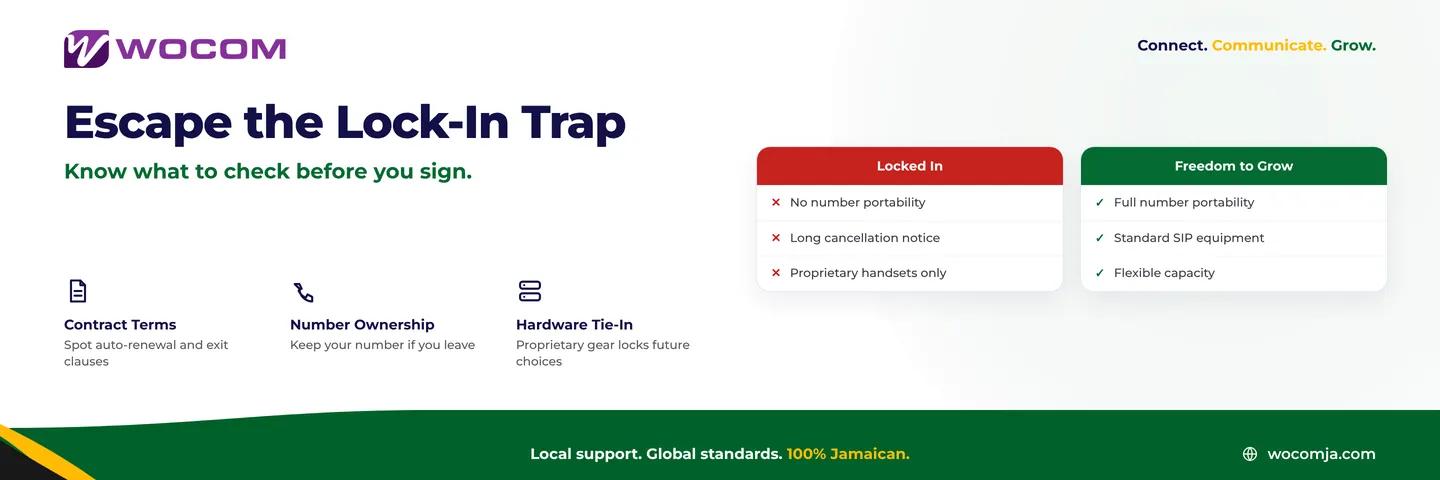
6. Contract Lock-In and Early Termination Penalties
Annual or multi-year contracts are common in business telephony, and they typically include early termination clauses that can equal several months of remaining fees. A two-year contract that looks affordable in month one becomes expensive if your business needs to restructure, downsize, or change providers before the term ends.
Ask: What is the minimum contract term? Is the early termination fee a flat figure or a percentage of the remaining contract value? Are there automatic renewal clauses that extend the term unless you provide written notice by a specific date?
Month-to-month arrangements may carry a marginally higher monthly rate but provide flexibility that protects cash flow — particularly important for growing or seasonally variable businesses.
7. Support Tier Costs
The base plan may include email-only support during standard business hours. Getting a technician on a call, accessing weekend coverage, or securing a guaranteed response time often sits behind a paid support tier. For any business that depends on its phone system to operate, discovering that emergency support costs extra is an unpleasant experience — and it almost always surfaces at the worst possible moment.
Ask: What support channels are included in the base plan — phone, email, live chat? What are the guaranteed response times? Is after-hours or emergency support available, and does it carry an additional cost? Who do I contact if lines go down on a Sunday morning?
How to Compare Two Provider Quotes Properly
When you receive competing proposals, build a total-cost-of-ownership comparison across 24 months. Add the setup fee, multiply the monthly rate by 24, add projected DID rental fees, add your estimated international call spend at each provider's published rates, and include any support tier uplift. The provider with the lower headline rate is frequently not the cheaper option when you run this calculation to completion.
Also confirm that the provider holds an active licence from the Office of Utilities Regulation (OUR). A licensed carrier owns or has contracted access to real Jamaican network infrastructure. An unlicensed reseller cannot guarantee equivalent service levels and carries no regulatory obligation to your business if something goes wrong. Ask any provider for their OUR licence number and verify it independently.
Get a Transparent, Itemised Quote from WOCOM
WOCOM is a licensed Jamaican telecommunications carrier. Every quote we issue itemises setup, monthly line rental, number costs, channel allocation, international rates, and support coverage — with nothing buried in an appendix. We also provide a clear porting timeline and an interim forwarding arrangement to keep your current numbers working throughout the transition.
Ready to see what your phone system should actually cost? Contact WOCOM for a side-by-side breakdown against your current or prospective provider's quote. We will walk through every line item with you so there are no surprises on your first invoice.
Reach us via WhatsApp, the contact form at wocomja.com, or call our sales team directly. Businesses across every parish in Jamaica — from Kingston commercial districts to Montego Bay hospitality operators — have made the switch and consistently tell us the real savings were larger than they expected.
Continue exploring
Ready to upgrade your communications?
Talk to our team about the right solution for your business.
Book a Demo Contact SalesEverett Kildare is WOCOM's voice and infrastructure specialist, with more than 25 years of experience designing and running carrier-grade voice, SIP and virtualization infrastructure. Holding a BSc in Information Technology, he has built, secured and migrated phone systems for businesses of every size. Everett writes WOCOM's technical coverage of SIP trunking, cloud PBX, contact centres, business continuity and migration.