Phone Tag Jamaica: How Cloud PBX Ends the Missed-Call Loop for Good
It starts with good intentions. Your customer calls your Kingston office at 10:15 a.m. You are on another call. They leave a message. You call back at 11:30 a.m. — they are in a meeting. They try again at 2:00 p.m. — your line is busy. By 4:00 p.m., they have called a competitor and your unreturned message is just a red number on a missed-call list nobody is watching.
Phone tag is so common that most Jamaican business owners accept it as unavoidable. It is not — it is a revenue leak, and in 2026, the tools to seal it are built into every modern Cloud PBX system.
What Phone Tag Really Costs Your Business
The first missed call is usually innocent. The second starts to feel like friction. By the third, the caller has formed an opinion about your business — and it is not favourable.
Callers who cannot reach a business within two attempts are highly likely to try a competitor before making a third attempt. In Jamaica's service sectors — insurance, law, real estate, logistics, healthcare — most enquiries come from callers who already have options. When they experience a repeated missed-call loop, the path of least resistance leads somewhere else.
There is also an internal cost. When team members spend time chasing unanswered callbacks, that time comes out of billable hours, client service, and focus. A single phone-tag chain involving three calls each way is not just a nuisance — it is a measurable productivity drain multiplied across every caller your business handles in a week.
Why Traditional Setups Make Phone Tag Worse
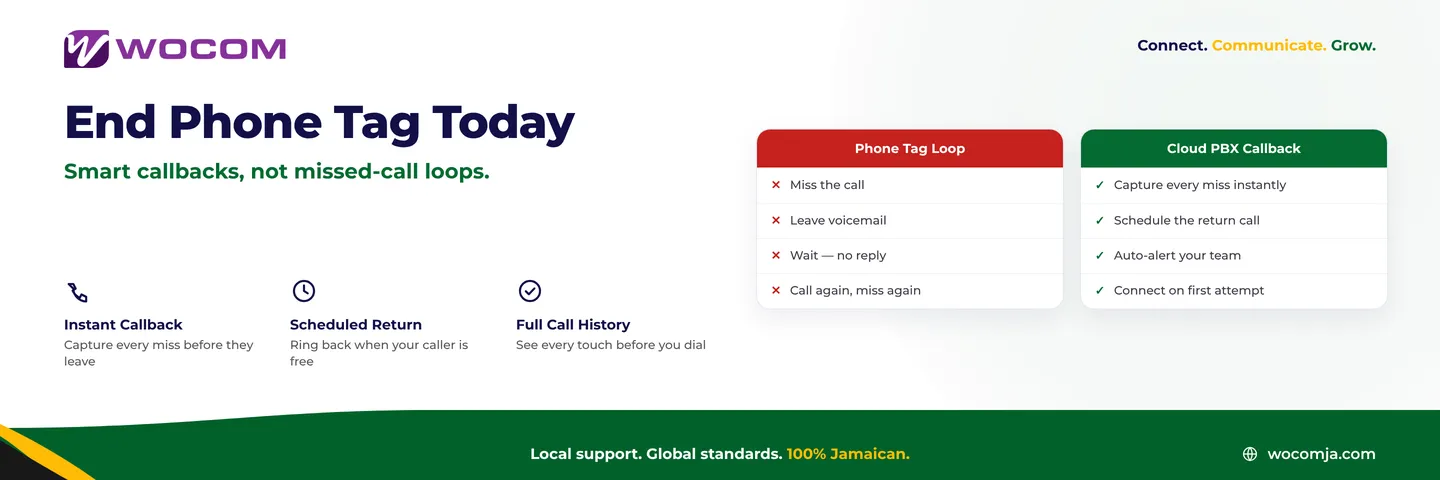
Legacy phone systems and basic mobile lines share a structural weakness: they record a missed call, and they do nothing else. The number sits in a log. Someone has to notice it, decide to act, find a free moment, dial manually, and hope the timing works. That chain has at least four failure points before the conversation even begins:
- Visibility: Missed calls on a shared system often go unassigned. Everyone assumes someone else is handling it.
- Priority: Without context, a callback list is just a list. High-value enquiries sit beside cold calls with no way to tell them apart.
- Timing: Even a motivated callback agent has no idea when the original caller is available. Dialling blind into a busy afternoon restarts the loop.
- History: If the second callback attempt falls to a different team member, they start from zero — no record of what was said or what the caller actually needs.
None of these problems require new hardware to fix. They require a smarter system.
How Cloud PBX Ends the Missed-Call Loop
A properly configured Cloud PBX system intercepts the loop at every failure point. Here is how each one is addressed:
Automatic missed-call alerts. When a call goes unanswered, the system immediately pushes a notification — to the dialled extension, to a supervisor, or to a shared team inbox — so the miss does not disappear silently into a log nobody reviews.
Virtual callback queuing. Rather than asking callers to wait on hold or simply hang up, Cloud PBX can offer the option to hold their place in the queue and receive an automatic callback when an agent is free. The caller is matched with the next available team member without redialling manually.
Presence and availability indicators. Real-time presence shows whether each extension is idle, on a call, or in Do Not Disturb mode. A reception team with a live view of availability stops routing callbacks to colleagues who are already tied up — the single biggest cause of repeated misses in small and medium Jamaica businesses.
Callback scheduling through AI reception. When a caller reaches WOCOM's Alex AI receptionist outside business hours, Alex can offer to schedule a specific callback time. The caller names a slot, Alex captures their name, number, reason for calling, and preferred window, and the system creates a task visible to the team the next morning. No sticky notes, no "I thought you had that one."
Unified call history per contact. When the callback finally connects, the team member pulling up the record can see every touch point — when the original call came in, what was left in voicemail, which callbacks were attempted. They walk into the conversation informed rather than apologetic.
Presence Features That Stop Phone Tag Before It Starts
The fastest way to end a missed-call loop is to avoid the miss entirely. Cloud PBX presence management makes this achievable even for small teams spread across Portmore, Montego Bay, or multiple offices.
Busy Lamp Field (BLF). A reception console or sidecar on a desk phone shows a live indicator for every extension. Green means available; red means on a call. A receptionist can see in an instant whether to transfer or offer to take a message — no guessing, no unnecessary hold time.
Simultaneous ring and find-me / follow-me. For key personnel such as sales leads or account managers, Cloud PBX can ring their desk phone, mobile, and softphone at the same time. If none answer within the configured ring time, the call rolls to a colleague or a voicemail that delivers the audio by email. A call chain with three landing points is much harder to miss than one that terminates at a single desk.
Scheduled Do Not Disturb. Team members in a client meeting can set DND on a timer. The system takes messages during that window and automatically lifts the restriction at the scheduled time — no manual reset, no calls missed because someone forgot to turn DND off.
Building a Callback Workflow Your Team Will Actually Follow
The tools only work if the workflow is simple enough that every team member uses it consistently. A practical missed-call workflow for a Jamaica SME looks like this:
- Route every missed call to a shared team voicemail with voicemail-to-email enabled. This puts the callback task in a monitored inbox, not on a single person's phone that may be switched off.
- Assign callback ownership in the portal. Configure rules that route missed calls from specific departments or DIDs to designated users or ring groups. Clear ownership eliminates the diffusion-of-responsibility problem that lets callbacks fall through.
- Set a callback service level. Commit internally to returning calls within a defined window — one hour during business hours is a solid starting point for most Jamaica service businesses. Track compliance in your call logs.
- Read the AI receptionist context first. If Alex answered the call before it went unanswered, the transcript and the caller's stated reason are already in the system. The callback agent reads the note before dialling — and the caller does not have to repeat themselves from scratch.
When Phone Tag Points to a Staffing Problem
If your team regularly loops through missed calls despite a solid callback workflow, your call data may be telling you something about coverage rather than process. A high missed-call ratio during specific hours points to understaffing at peak times — not a routing problem.
WOCOM's Cloud PBX portal gives you hour-by-hour call volume data. If calls between 11:00 a.m. and 1:00 p.m. have a disproportionate miss rate because your team rotates lunch simultaneously, the fix is a staggered break schedule — not a more complex callback rule. The data does not guess. Used properly, it turns chronic phone tag from a recurring complaint into a solved operational problem.
Stop the Loop — Talk to WOCOM
WOCOM's Cloud PBX is built for Jamaica businesses that take their calls seriously, with presence tools, smart routing, virtual queuing, and AI-powered after-hours reception built into the platform. Whether your team is five people in a single office or thirty staff across multiple branches from Kingston to Montego Bay, the missed-call loop is not inevitable.
Contact WOCOM today to audit your current call routing and identify exactly where your missed-call loop is breaking. Visit wocomenterprise.com or reach out through the portal to arrange a walkthrough with our team.
Continue exploring
Ready to upgrade your communications?
Talk to our team about the right solution for your business.
Book a Demo Contact SalesEverett Kildare is WOCOM's voice and infrastructure specialist, with more than 25 years of experience designing and running carrier-grade voice, SIP and virtualization infrastructure. Holding a BSc in Information Technology, he has built, secured and migrated phone systems for businesses of every size. Everett writes WOCOM's technical coverage of SIP trunking, cloud PBX, contact centres, business continuity and migration.